
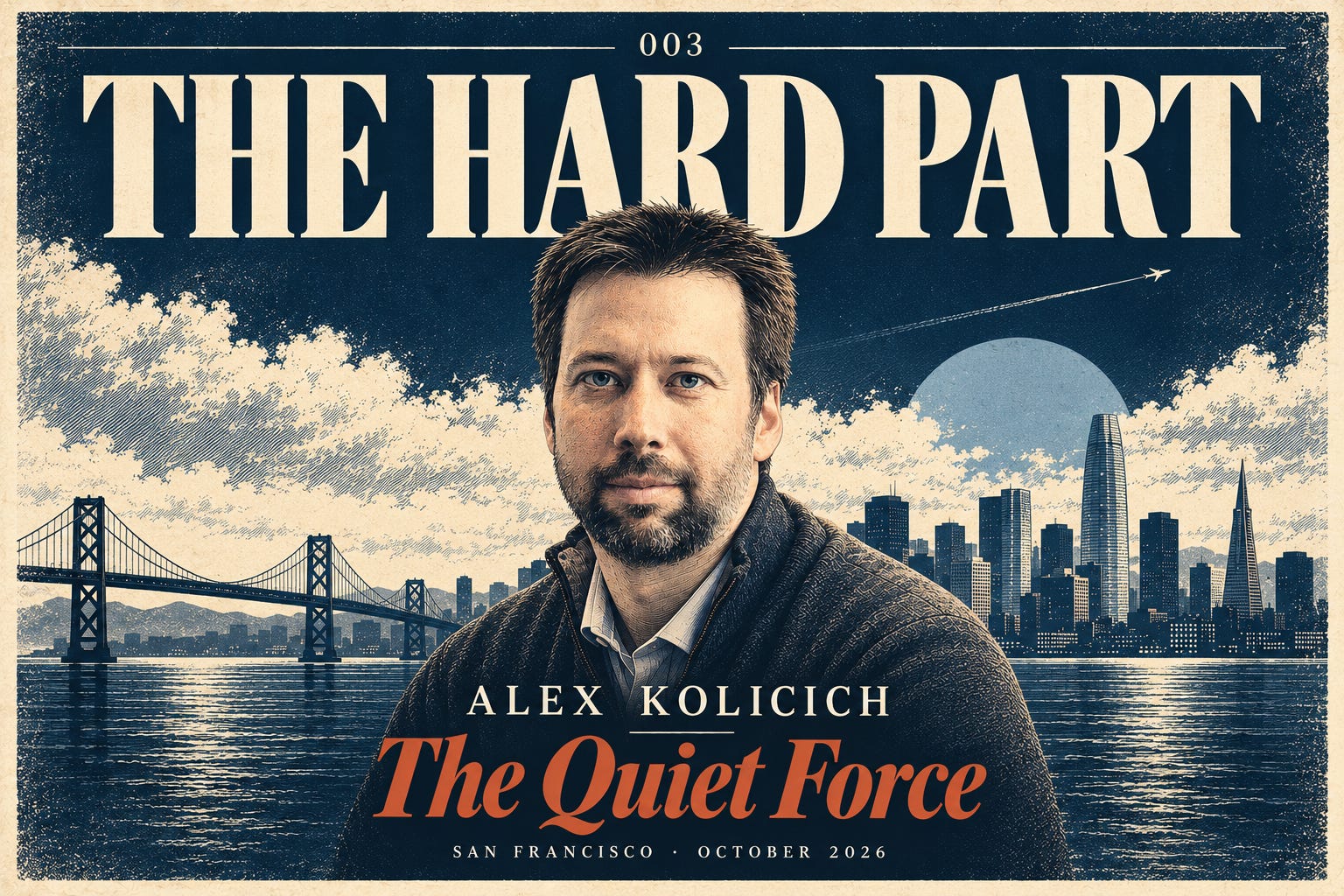
I am scootering down the Embarcadero on a sunny Tuesday in late August. My San Francisco friends tell me this is unusual after a summer of cloud and fog. I pass under the Bay Bridge, cruise by the Ferry Building and follow the water toward one of the old piers.
I buzz my way in and walk into one of the coolest offices I have ever seen. The building dates to 1916, when these piers helped move trade and freight through San Francisco. The waterfront handled California’s agricultural goods and supported military logistics during World War II. The space was once a San Francisco office of Renaissance Technologies, the quantitative investment firm founded by Jim Simons.
Old timber beams run overhead in a huge three-level space of steel, marble, concrete and glass. Massive windows look out over the Bay. The office is open enough that I can see people on calls, working on MacBooks and meeting with founders across the room.
It feels part café, part art museum. There are leather couches and rugs, a beautiful bar, and cans of nicotine pouches from Sesh, an 8VC portfolio company, sitting at the counter. Daisy, a fluffy dog, is hanging around the bar. Founders keep coming in to pitch and meet the team. It is casual, and everywhere I look someone is working.
I am here to meet Alex Kolicich, one of 8VC’s founding partners. Almost everyone I spoke with who knows him well calls him Koli. His assistant, Mackenzie Walford, brings me into the main boardroom. It is an enormous room enclosed entirely in glass. I can still see the rest of the office, and anyone walking past can see who is inside. The scale gives it a sense of importance. Alex joins a few minutes later.
Before we start, Mackenzie walks back carrying a book. It is called The Computer: A History from the Seventeenth Century to Today, a massive illustrated coffee-table history of computing. “I’ve been waiting for this book for a long time,” Alex tells me. He starts flipping through it and almost immediately jumps toward the end.
“I wonder if this includes AI.”
It does.
The firm has spent the last decade backing companies across defense, logistics, healthcare, manufacturing, robotics and software. Its portfolio now includes Anduril, Cognition, Quince, Ramp, Saronic, Addepar and Bedrock Robotics. Spend enough time around technology investors and you keep running into 8VC.
Alex is much less public than the people and companies around him. His longtime friend and co-founder Joe Lonsdale has more than 300,000 followers on X. Alex has about 7,000. Paul Lee worked for Alex at Mithril and later co-founded Patlytics, which 8VC backed. He told me, “Not a lot of people know he’s actually the Chief Investment Officer.”
His career is kind of ridiculous when you lay it out. He grew up in Hamilton, Ontario, ended up at Waterloo, interned at Google, went to work for Peter Thiel at Clarium, moved into venture with Mithril, joined Formation 8 and then helped build 8VC. Along the way he has been involved with companies ranging from Helion and AppDirect to Quince, Deliverr, Anduril, Cognition and Bedrock.
Paul also called Alex “probably low key the most brilliant/sharp investor in Silicon Valley.” Then he went further.
“8VC is 8VC because of Alex.”
Drew Oetting, another founding partner at 8VC, told me, “Koli is the clearest thinker I have ever met.” I wanted to understand what they were seeing.
Alex’s first computer was an old machine with a floppy drive in Hamilton, Ontario.
Alex Kolicich was born in Hamilton in 1985. He grew up in a Serbian household headed by his single mother. For most of the twentieth century, Hamilton’s identity was tied to steel. Stelco and Dofasco dominated the industrial waterfront and, at their peak in the late 1970s, employed roughly 30,000 people between them. By 1990, as Alex was entering school, that number had fallen to around 23,000. By 2003, the year he left for Waterloo, it was closer to 12,500.
Hamilton was still Steeltown, though the city Alex grew up in was already changing. Alex compares his neighborhood to social housing or “the projects” in the United States. There was little money. Alex says there were gangs in the area. His school later finished near the bottom of Ontario in an early round of standardized testing. He estimates that about ten percent of his high-school classmates went on to university.
When I ask about that childhood, Alex says he remembers it fondly. He knows there was little money and says he could construct a story about hardship. The memories he offers are of his mother, family close by and neighbors looking out for one another.
His relatives lived close enough to help look after him. His mother was close with his best friend’s mother. The neighborhood had sizable Serbian and Indian communities.
Computers were an interest he pursued largely on his own. He cannot remember the initial spark. Nobody around him shared the interest or had much guidance to offer about where it could lead.
When he asked his mother for a computer, she found him an old machine with a floppy drive. When he asked for an internet connection, she got him that too. There was not much money in the house.
With the computer and the internet, he told me, he did not need anything else.
One uncle had gone to college. Nobody in his immediate world worked in technology. He had little sense of the industry he would eventually join, but he already knew he wanted to be a computer guy.
He just started messing around with the computer. At school he became “the computer guy.” He helped the computer teacher manage the network. He made his own video games. “I learned to make video games from first principles,” he told me. His classmates voted him the person most likely to become Bill Gates as well as valedictorian.
Gaurav Jain, now a co-founder of Afore Capital, met Alex a month before their software-engineering program started in 2003. Both had signed up to become residence computer consultants and arrived early for training. “Being the nerds we are,” Gaurav told me, their first university activity involved helping other people with computers.
His first impression was that Alex was the smartest person he had met, with a chip on his shoulder. Alex came from a modest background and had enormous ambition. More than twenty years later, Gaurav says his view of Alex’s intelligence has held up.
Alex was the student professors loved: he showed up, paid attention, understood the material and crushed the exams. Gaurav struggled to make it to class, “though in my defense I was very involved with extracurricular activities!” The conversations he remembers best happened in the cafeteria. They could spend hours debating politics, vegetarianism, entrepreneurship or whatever else had caught their attention.
Waterloo is where economics became Alex’s second obsession. He credits professor Larry Smith, whose teaching made the subject feel alive. Alex kept taking economics courses from his first year through his fourth.
Alex says he never intended to start a venture firm. At Waterloo, he was following the subjects that held his attention: computers and, increasingly, economics.
He played poker at Waterloo and used some of the winnings to help pay for school. He also met his wife through the Serbian club. He told me he joined to meet girls. It worked.
Waterloo’s co-op program mattered just as much. Oggie Nikolic was a few years ahead of Alex. He was Alex’s first internship host and helped bring him to California for two internships at Google.
Oggie watched Alex get absorbed in Silicon Valley: the history, the people, the lore around the companies, and the idea that a relatively small group of engineers could build something used by hundreds of millions of people.
Alex did not arrive feeling like he obviously belonged there. He remembers having a fair amount of Canadian imposter syndrome. He was working beside people from places like Stanford and, in his head, these were the people who were supposed to be the real thing.
Then he started finding mistakes in a Stanford graduate’s work. He realized he could play at that level. Oggie remembers the ambition being obvious almost immediately. Alex kept asking him the same kinds of questions: Who should I learn from? How do I stand out? How do I get promoted? How do I get more responsibility? What should I be doing next?
Oggie remembers Alex’s work as exceptional in both quality and volume. Alex also had no problem walking up to a senior executive and starting a conversation, then talking just as easily to an intern. Oggie says that has always been him.
Alex worked on the development and launch of Google Checkout, the company’s attempt to make buying things online faster by letting users pay with a single Google login. Checkout launched in June 2006. Then he moved into Google Research and worked on Street View before and during its launch.
Google’s earliest Street View prototype involved cameras strapped to a van. In May 2007, the company published street-level imagery for just five cities: San Francisco, New York, Las Vegas, Miami and Denver.
Alex later described the two projects in an interview Checkout had a large team and abundant resources, which he thought could hurt its development. Street View had fewer resources and had to be scrappier.
In that interview, Alex also described a recruiting problem he encountered after Google: competing for engineers who could choose a much bigger employer. People had to believe in the mission strongly enough to join before the outcome was obvious.
By the time he left Google, California did not feel like some inaccessible place filled with Stanford geniuses anymore. It felt like somewhere he could build a career. His next major job came from Waterloo’s co-op job board.
Rosco Hill, another Waterloo graduate who would become Alex’s boss at Clarium, had posted an engineering job on the co-op board. Alex had never heard of Clarium and barely knew who Peter Thiel was. That surprised me. I was thinking of Peter in 2026: Palantir, Founders Fund, Zero to One, the Thiel Fellowship and decades of technology investments.
The Peter Thiel Alex was about to work for was already very successful. PayPal had sold to eBay. Thiel had made the first outside investment in Facebook. Palantir existed, and Founders Fund had launched in 2005. But much of the mythology around him today had not happened yet. The Thiel Fellowship did not exist. Palantir was still a young, secretive company.
Alex had another offer from Deutsche Bank to join an exotics trading desk. A friend at Deutsche told him to take the Clarium job. Clarium was a global macro hedge fund that, at its peak, managed billions of dollars. It made bets on currencies, commodities, interest rates and public companies based on its view of the global economy. For a software engineer who had become obsessed with economics at Waterloo, this was pretty much heaven.
Clarium flew him business class for his interview and put him in a nice hotel. An early off-site was at Pebble Beach. The perks were generous enough that Alex remembers a theory behind them: get people accustomed to a certain lifestyle and leaving becomes harder.
For a while, he loved it. Rosco reported to Joe Lonsdale. Alex remembers his first interview with Joe lasting around ten minutes. It was the beginning of a working relationship that would last decades.
Ajay Royan, Alex’s future boss at Mithril, says he met him sometime between 2006 and 2008 through Joe, who was building out a quantitative team at Clarium. Ajay had a soft spot for Canada and wanted to recruit at Waterloo and the University of Toronto.
“Peter is great to work for early in your career,” Alex told me. “It is not doing PowerPoint and fixing slides.” Alex chose to cover China, oil and metals. Clarium gave him room to decide what to investigate and how to do it.
“Buy oil” was an instruction Alex had to turn into a research agenda. School had taught him to work through structured problems. Clarium left much more of the task for him to define. He had to decide which questions to pursue, which companies to speak with and which information might change the trade.
Alex remembers the work as fun, but a tough way to live. He spent about a year in New York trading Asian markets. He would stay up until midnight or one in the morning watching markets, sleep for a few hours, then be back in the office around six.
His laptop came home with him. Stop-loss alerts could wake him in the middle of the night. Oil prices followed him into sleep, too.
“I would dream about oil,” he told me.
At Clarium, Alex also advised and collaborated with the early Palantir team on financial applications, work he describes as Palantir for finance. Eric Woersching, a Clarium colleague, remembers Alex contributing code to the finance project.
A few years later Joe, a Palantir co-founder, would leave the company and start Addepar, applying software to another messy financial-data problem: helping wealthy families and institutions understand what they actually owned.
Ben Verschuere joined Clarium around the same time as Alex and remembers one prediction that stuck with him. They were studying a British company that still appeared healthy. Alex thought the financial crisis would hit it much harder than the market seemed to expect. The company later went bankrupt.
Ben remembers the culture around Peter as obsessed with whether an idea was actually true, not whether it sounded different. “Just being contrarian is wrong,” he told me. Alex makes a similar distinction. He told me most investments that make money are consensus bets. You still have to win your way into the deal.
Ajay remembers debating fairness, justice and libertarian ideas with Alex, in conversation and over email. Those debates were part of the social life around Clarium. Anything could be put on the table.
When Clarium’s head of risk left, Alex took on more of the fund’s risk work. People from those years still describe him as Peter Thiel’s “math guy.”
Peter, Alex says, did not need a math guy. Alex tells me about a trade he thought Peter had put on too aggressively. To test it, he built a Monte Carlo simulation, running the problem through many possible market paths.
The question was how likely Peter was to get stopped out: how often the market might move far enough against the position to trigger its exit.
The answer was roughly fifty percent. Alex wanted to catch Peter out.
Alex began explaining the trade and what he had modeled. Peter gave him the answer almost immediately: about fifty percent. He had done the math in his head. It was the same result Alex had reached with the simulation.
So much for catching Peter out. Alex says being around Peter showed him what it meant to be the best at something. Then he tells me about a chess game.
Peter was playing chess against Joe Lonsdale and Joe’s brother Jeff. Joe was not a casual chess player. As a kid, he studied the game obsessively. He has said he was studying thirty or forty hours a week for several years, won the California K-6 state championship in both fifth and sixth grade, and later carried a chess rating around 2000.
Peter played blindfolded. Joe and Jeff could see the board; he had to keep the position in his head as the moves were called out.
At one point, a move was called out incorrectly. Peter caught it. The move, he said, could not have happened. He went on to win.
“Peter smoked Joe and Jeff while blindfolded,” Alex told me.
Alex told me it is easy to convince yourself you have no gaps in your knowledge. Clarium gave him a close view of how much he still had to learn.
Then Alex did something Eric Woersching still gives him a hard time about. According to Eric, there was a bonus coming. Alex left the trading desk and went back to Canada for a master’s in economics at the University of Toronto. He told me he did the degree “just for fun,” which is not my idea of fun.
Eric remembers Alex returning to Clarium after the master’s, still absorbed in macro and working on energy, a subject Peter kept coming back to.
Clarium had given him fortitude, Alex told me. He had enjoyed trading, watched prices every day and learned to live with the pressure. He also saw the fragility of the career. One or two bad years could leave a trader unemployable after years of making money. The work still interested him. The question was whether he wanted to keep living that way.
When we spoke, Alex still found public markets as interesting as venture. He can buy a public position, change his view and sell it. In venture, he has to think through a commitment that can stay with him for years. He describes the work in terms of long-term, durable value.
Alex told me money has never been much of a motivator. He went back to school because economics interested him. He also considered a PhD in computer science.
Twice. Alex says he applied to study for a PhD with Geoffrey Hinton around 2008, then again around 2012. He turned down the opportunity both times. Hinton spent decades pushing neural networks when much of computer science was skeptical of them and later won the 2024 Nobel Prize in Physics for foundational work that helped make modern machine learning possible.
In 2012, Hinton, Alex Krizhevsky and Ilya Sutskever published the work that became known as AlexNet. It dramatically improved image recognition and became one of the landmark results of modern deep learning. Sutskever later co-founded OpenAI as well as Safe Superintelligence Inc.
The “Alex” was Alex Krizhevsky. When Alex Kolicich tells the story, he jokes:
“I could have been the Alex in AlexNet.”
He passed on Hinton’s lab again and joined Mithril.
Ajay Royan co-founded Mithril with Peter Thiel in 2012 and recruited Alex to help build its investment team. Ajay wanted to move away from quantitative investing into backing companies over many years. Alex remembers Ajay’s ambition as something like a Berkshire Hathaway for growing technology companies.
Ajay deliberately hired people with no prior venture experience. He looked for raw intelligence, intellectual curiosity and demonstrated ability in another field. Alex arrived with engineering experience and almost none of the vocabulary of venture capital. He told me he did not know what a Series A was.
Mithril’s approach gave him an unusually broad education. The firm looked across industries for businesses approaching important stages in their growth, and Ajay wanted companies that could endure.
The first fund raised roughly $540 million. Ajay remembers a $20 million check feeling like a major commitment in those early years; $100 million in one company was an extraordinary proposition. He wanted the team looking in places like Kansas City and Calgary. He describes venture then as “make your own adventure.” Ajay says Mithril sometimes spent five years getting to know a company before investing.
The investments Alex helped lead included AppDirect, Helion and C2FO, whose platform let suppliers offer buyers a discount for paying approved invoices early. The firm’s work also included oil and gas and surgical robotics. Ajay remembers the team being viewed as Sand Hill Road outsiders. He liked finding less obvious ways into an investment and thought of the work as a kind of asymmetric warfare. Alex loved solving the puzzles.
Ajay’s search for Canadian talent continued at Mithril. He was looking for exceptional founders, including the Canadians building AppDirect and Instacart. He wanted businesses that could stand on their merits.
Daniel Saks first met Alex over breakfast at Café de la Presse in San Francisco in 2012. Daniel was building AppDirect, a platform that helped businesses find, buy and manage cloud software. What he remembers is the quality of Alex’s questions. “He dug in quickly and deeply,” Daniel told me.
Alex later led AppDirect’s Series C at Mithril. Years later, at 8VC, Alex backed Daniel’s new company, Landbase, from seed through Series A. Daniel says Alex did not force a company into a familiar pattern. He moved quickly and, when he said he would do something, followed through.
Daniel also values Alex’s respect for the entrepreneur’s time. “He works to understand what is actually true about the business, tells you exactly what he thinks, and gives you clear guidance without wasting cycles,” he wrote to me.
Alex brought Paul Lee, then a Waterloo student, into Mithril as an intern. When Mithril was evaluating Sonos, Alex bought the speakers and played around with them himself. Paul remembers Alex caring deeply about whether the team and culture would let people do their best work.
Ajay points out that early-stage presentations can make every business look attractive. For one potential investment, Alex spent a week inside the company. He showed up as an engineer and got close to its technical team. Ajay remembers how easily he could connect with people across a business, through technical skill, empathy and an understanding of the work.
On their first call, Paul asked Alex where he should stay in San Francisco. Alex wanted to know whether he was a “frat bro” or a “hipster.” If he was fratty, the Marina. If he was a hipster, the Mission.
Paul has considered himself an Alex loyalist ever since. Some of his own deeply held beliefs were shaped by working with him. One line he still remembers is that Silicon Valley had made a lot of smart people stupid.
Mithril also put Alex into categories far outside conventional software. In August 2014, Mithril and Y Combinator invested $1.5 million in Helion Energy. At the time, fusion was nowhere near the venture category it is today.
Helion had come out of work at MSNW, a University of Washington spinout. Instead of building a gigantic conventional fusion machine, the company was pursuing a smaller pulsed system and trying to recover electricity directly.
Alex told me Mithril invested at roughly a $20 million post-money valuation. Helion’s June 2026 financing valued the company at $15.5 billion. Mithril still held a stake. Alex estimates Mithril’s position is worth over $1 billion.
More than a decade separates Mithril’s investment from that valuation. Fusion has required years of engineering, new machines and additional financing. At Clarium, Alex had watched prices move every day. Helion gave him a stake in work that could take much of an investing career to mature.
Eric’s running joke is that Alex kept missing out on the money. He had contributed heavily at Clarium and to the early financial work with Palantir, then gone back to school. Later he did important work for Ajay, again without the financial rewards Eric thought he deserved.
After roughly two and a half years at Mithril, Alex wanted to concentrate on earlier-stage investing. He had backed Helion early at a firm focused mainly on later-stage companies. Joe Lonsdale had started Formation 8 and recently raised its second fund. Alex had known him since Clarium.
Moving meant leaving Ajay, Peter and the team he had helped build. Alex wanted to do that on good terms. He called Trae Stephens, an investor at Founders Fund, and asked if he knew someone who could take the role.
Trae connected him with Matt Grimm, who was coming to the end of his time at Palantir. Matt had been talking to Trae about what to do next. Matt arrived at Mithril only a few weeks after Alex left.
Ajay would have preferred to keep Alex. He also sees what the move eventually gave Alex: an opportunity to build 8VC from scratch. He recognizes much of Mithril’s DNA in the firm, including its willingness to learn unfamiliar industries. The friendship lasted. Even after long gaps, they can pick up the conversation where they left it.
Formation 8 had been built by Joe Lonsdale, Brian Koo and Jim Kim around a strategy of helping ambitious Silicon Valley companies expand into Asia. It raised a $448 million first fund and then a $500 million second fund, and it had already backed companies including Oculus and RelateIQ.
Inside Formation 8, investment priorities were starting to diverge. Joe wanted to spend more of his time on earlier-stage companies in the United States. Brian Koo was more interested in growth investing and the firm’s original focus on expansion into Asia.
In late 2015, the partners decided not to raise a third Formation 8 fund. They would keep managing the existing portfolio while going their separate ways. Joe’s side of the team became the foundation for a new firm.
Drew Oetting had been Joe’s chief of staff at Addepar before moving with him to Formation 8. Drew says they knew they were missing someone with a deep understanding of investing. Alex was analytical, technically fluent and able to turn complicated work into a simple investment question.
The new firm was initially called 8 Partners and eventually became 8VC. Fifteen of Formation 8’s 25 employees ended up there.
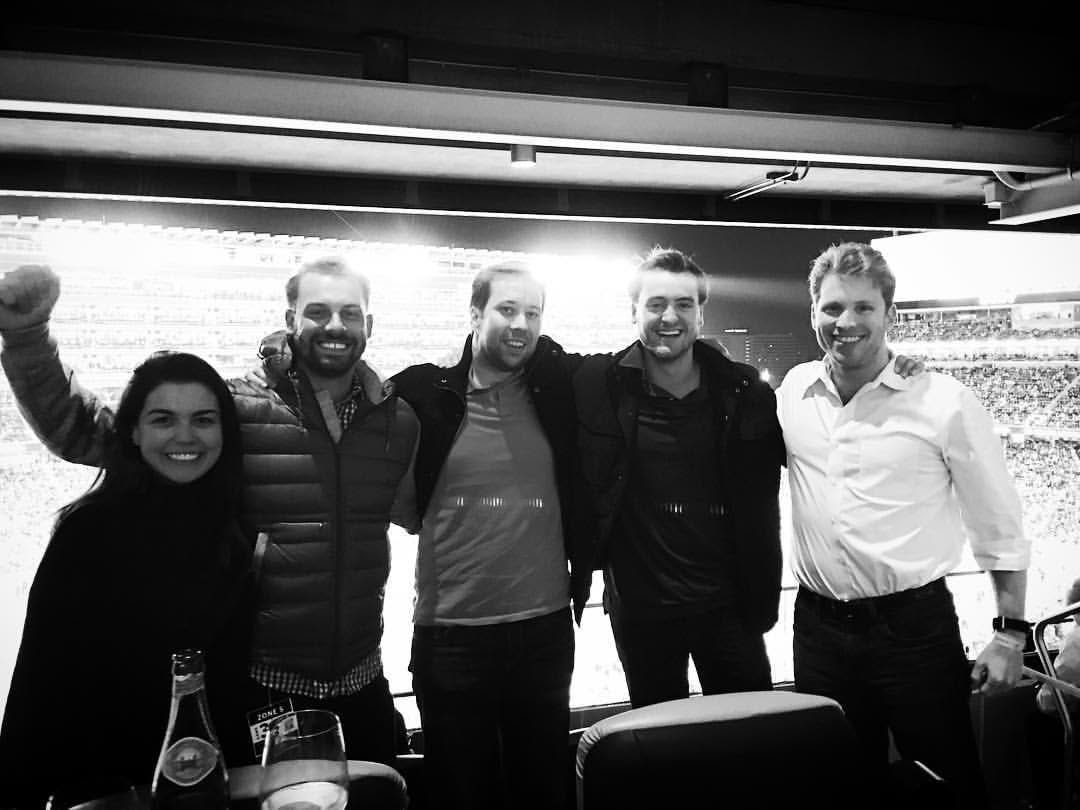
Then they had to raise the money. Bela Becerra, who has worked with Alex at 8VC for eight years, describes the earliest fundraising period as relentless. Joe, she says, took about a thousand meetings with prospective fund investors.
8VC raised a $425 million debut fund and a separate $50 million seed fund. Alex remembers the task as starting a brand from scratch.
Inside the firm, Drew describes Alex as the center of gravity for investment decisions, translating complicated technical and market analysis for colleagues with different backgrounds. Alex says the firm has kept improving with each fund.
Drew calls venture a “chaos machine.” Decisions come quickly, with incomplete information about founders, markets and technologies that keep changing. In his telling, the people making them may also have the attention span of a gnat. Drew has brought Alex deals and spent thirty minutes talking through the market, the technology, the thesis and everything else he had learned.
Alex will listen and then ask, “Is the team good?” Drew sometimes realizes he has spent thirty minutes talking without answering that question.
Bela laughed when I asked for a great Joe-and-Alex story. They have worked together for something like fifteen years, she said, and somehow neither seems to have many stories about the other.
Alex says they wanted a boutique firm with enough time to work closely with founders. In the firm’s investment committee, he says, they try to set aside who else has invested and evaluate the fundamentals. Why should this exist? Why now? He wants the discussion to reach the business itself: what the founder is trying to build and whether the opportunity is there.
He sometimes pushes the question out a hundred years. Should the world still work this way then? Should this business exist at all? He is also asking whether this is finally the right moment to build it.
8VC also creates companies through its incubation program, 8VC Build. If the partners believe a business ought to exist but cannot find a company to back, Alex says, they consider building it themselves. Bela says the partners also have to be honest about whether 8VC is uniquely equipped to build it and help its founders succeed. The firm’s involvement can include validating the opportunity, bringing together a team and helping with early customers. Saronic, which makes autonomous vessels, is one of 8VC Build’s companies.
Alex wants to work like a co-founder. He wants to understand the founder’s vision, work closely enough to contribute and have time available when he is needed. He says a personal connection helps. He talks about wanting to mindmeld with a founder.
Alex has ambitions to establish 8VC as one of the defining institutions in venture capital, with a reputation that reflects the scale of what the firm has built. He acknowledges that recognition hasn’t always come naturally, and despite 8VC’s track record, he still has to fight to win a place in the companies he’s eager to back.
Matt Grimm, now a co-founder of the defense company Anduril, describes Palantir’s fundraising as a black box. Financing was separate from the teams working in the field. Arriving at Mithril meant learning a part of company-building he had barely seen.
He started calling the guy he had replaced. How did sourcing work? How were companies valued? What belonged in an investment memo? How did a junior investor convince an investment committee to back a company? Alex recommended books and other investors to talk to. After leaving Mithril, he also kept introducing Matt to companies.
Matt remembers the introductions as unusually generous. Two years later, Matt called him from the other side of the table.
I flew into John Wayne Airport on a hot day in late August. It was my first time in Orange County. From the airport I drove over to Costa Mesa and Anduril’s headquarters.
I had nerded out on Anduril for years, so I was almost stupidly excited pulling up. Disneyland, fittingly, was only about twenty minutes up the road in Anaheim. I was heading to my own version.
A huge American flag hung on the side of one of the buildings. Beside it, enormous lettering read: “THE GRIND THAT WILL WIN.”
You do not simply wander into Anduril. I pulled up to a security booth, checked in, and from that point on was escorted everywhere. They walked me to another part of the campus and into a waiting area. Investors, visitors and tour groups kept coming through. Employees moved between buildings. Then security took me toward Matt Grimm’s office.
Hardware was everywhere. On the walk I saw work on IVAS, the Army augmented-reality headset program Anduril took over from Microsoft, and the company’s newer aircraft work with Archer. Around me were engineers working, people heading into meetings and tours moving through the campus. I kept thinking about what Anduril had been when Alex and 8VC first backed it.
Eventually I got upstairs to Matt’s office. Like a true Philly native, he had a Philadelphia Eagles helmet and a signed Saquon Barkley jersey.
Matt took me back to 2017, before any of this existed.
Anduril’s founders had plenty of pedigree. Palmer Luckey had already founded Oculus, which Facebook bought for billions. Trae had worked at Palantir and was investing at Founders Fund. Matt had been at Palantir and Mithril. Despite all of that, they struggled to raise money.
Matt remembers investors who liked the founders and the technology but doubted the government would ever buy from a company like Anduril. In other rooms, the objection was more basic: should a venture firm be funding a company that intended to build weapons at all?
Trae later described investors becoming more comfortable with risks that might have been “beyond the pale” in 2017. Google employees would soon revolt over work with the Pentagon. Defense technology was not the hot category it became years later.
Politics made it harder. Donald Trump had just won the 2016 election. Palmer had become a political lightning rod during his final period at Facebook, and Anduril’s first major product push was border security. Matt remembers politics as the highest-friction issue around 8VC’s early relationship with the company.
8VC was the third firm Anduril pitched, Matt told me, after Founders Fund and XYZ. Alex had already been helping Matt with the operational guts of starting the company: lawyers, board structure, voting dynamics and the pitch. Matt remembers Alex and Joe helping navigate the internal tension at 8VC and pushing the firm toward the deal.
Formation 8 had invested in Oculus. Now Matt was starting a company with Trae and Palmer and coming back to Alex for money.
Trae Stephens told me Alex had been plugged into hard tech and defense “since before we started Anduril.” He called him a great intellectual sparring partner and a cheerleader for technology. He also mentioned Alex’s love of boxing. Matt says Alex has been one of Anduril’s loudest advocates inside the firm and that 8VC has participated in every round.

Matt thinks of an investment as the start of a relationship that can last ten or fifteen years. His advice is to take money from someone whose name makes you happy when it appears on your phone. He also talks about how hard it is to stay in venture. Investors wash out, and founders have to want to keep working with you. Repeat founders returning to Alex are, to Matt, a particularly strong endorsement.
Early in his career at 8VC, Jack Moshkovich was working on a growth investment. He had the company’s model pulled up and told Alex it looked reasonable. Alex opened the spreadsheet himself. He clicked through the tabs and stopped at the eighth one. It was the sales tab. One salesperson was crushing quota. Almost everybody else was not.
If only one salesperson hit quota, Alex wanted to know if the business could really grow the way the model suggested.
Jack first joined 8VC as an intern. Alex initially did not want to hire him; when Jack returned later, Alex changed his mind. He has been Jack’s only boss ever since. Over the years Jack has collected what he calls “Kolicisms.” The most common one may be the simplest.
“Is it good or bad?”
Jack can bring Alex a company and start dressing it up. Market, product, growth, founder, whatever. Alex keeps trying to get it back to the thing that matters. Is the company good or bad? Is the founder actually good? Can this market structurally support a huge company? Before a meeting, Jack says Alex often already knows the one question he wants answered.
Vivek Gopalan, who works closely with Alex on investments at 8VC, knows the question too. Vivek can talk through a new category for a while and Alex will interrupt: okay, but is it a good company or a bad company? Vivek considers it a very dad move. He also sees many of the same founder strengths and mistakes recur across industries.
Alex told me it is less important how often you are right than how quickly you realize when you are wrong. Bela made almost the same point without prompting: the best investors are quickest to revise their views. She sees that in Alex.
During our interview, Alex admits that criticism can make him defensive. He can think he is doing good work and still have plenty to learn. He told me that becoming one of the best means getting past that first reaction and hearing where he falls short.
Alex says six months of deep study can make you pretty good at a subject. He looks for a few core insights: what determines success, what stands in the way, and which constraints might be changing. He reaches out to technologists who know where the frontier is and looks for a market opportunity in what they are building. His colleagues describe Alex studying market forces, competitors and the history of a category.
Vivek has adopted that habit in his own meetings. He wants to arrive knowing enough about the space to have an opinion he can test.
Bela sees Alex reduce a new company to the two or three things that must work for it to succeed. A long presentation can still fail to address one of those conditions. Alex wants questions that reach the heart of the business the entrepreneur is building. He dislikes the routine of challenging a founder and then laying on praise to soften it.
Alex says he goes back to evaluate his decision when a company he passed on does well.
Alex told me moving faster is one of the last things an investor learns. He can spend months learning a field before the company he wants to back arrives.
“The hard thing is to do nothing,” Alex told me. Early in a career, waiting is especially difficult. You want to prove that you are contributing.
His image is a softball pitch coming straight down the middle. When it comes, you need to crush it. You also need to be in the game.
When I asked Chad Byers, co-founder and general partner at Susa Ventures, what was unique about Alex, he answered: “Nothing super unique, other than I love the guy and he’s a true investor. Can invest in any market and make money. Also a great human, which is a nice kicker.”
Vivek Gopalan credits Alex with fund-returning investments across every category 8VC backs. Drew Oetting describes Alex’s work at Mithril in terms of multiple funds returned. Several of the largest holdings remain private. Their eventual cash returns are still unfolding.
8VC led the seed round for Quince, the clothing and home goods company co-founded by Sid Gupta. “We were literally just a PowerPoint,” Sid told me. Sid says Quince was not obvious to most investors. Alex focused on the technology and supply-chain layer underneath it, and how those could change the economics of commerce. The firm kept investing.
The firm had known Sid from his earlier business, Lolli & Pops. Alex and Drew later wrote: “Before he even began his search, we knew we wanted to partner with him on whatever he built next.” After the sale of Lolli & Pops, Sid studied Wish and began working on a different way to sell quality goods. His experience in retail had made him familiar with the costs that accumulated between a manufacturer and a customer.
Quince built direct relationships with manufacturers and a technology platform to handle procurement and distribution. Alex focused on how much cost and margin those changes could remove between factory and customer. Sid says Alex understands which advantages strengthen as the business grows: supplier relationships, volume and the technology coordinating them. “He deeply understands Quince’s business model, its moats and what is important as the business scales,” Sid wrote to me.
The company was originally called Last Brand, expressing the idea that the product itself could carry the value. Customers still wanted a recognizable identity. Last Brand became Quince.
Alex still thinks investors underestimate what Quince is building. Even after its growth, he told me, he regards it as a bet that has yet to become consensus. Sid describes his conviction in the company as unwavering.
Alex was also particular about the T-shirts. He had favorite brands, and it took Quince a long time to make shirts he was happy with. “Alex kept pushing us and pushing us,” Sid told me. They finally cracked it.
“Now I think he owns 100 of them!”
The investment memo Alex co-authored on Generalist focused on dexterity: plugging an Ethernet cable into a socket, repackaging products, assembling components and preparing kits.
At Generalist, Pete Florence, Andy Zeng and Andrew Barry are building foundation models for robotics. Pete had been a senior author on the research behind the robotics models PaLM-E and RT-2 at Google DeepMind. Andy was also a DeepMind researcher; Andrew had been a senior roboticist at Boston Dynamics. 8VC wanted to back Pete from the first conversation.
Generalist announced a $400 million Series B, led by Radical Ventures, in June 2026. Pete told me Alex led 8VC’s participation in that round. Six weeks after it closed, 8VC led an extension that brought in nearly $200 million at a reported $3 billion valuation.
Pete’s first impression of Alex: “Very sharp, no BS.”
I also went to Bedrock Robotics’ office, just off Market Street in San Francisco. Bedrock’s technology makes existing construction equipment autonomous. The company had recently moved in, and parts of the space were still being finished while meetings continued around us. Former Waymo engineers were everywhere, alongside people who had worked at Segment and Uber Freight.
Boris Sofman, Bedrock Robotics’ co-founder and CEO, had spent years building the consumer robotics company Anki before joining Waymo, where he eventually led its autonomous trucking work. Anki had shut down. He had also watched robotics and autonomous-vehicle companies raise huge sums of money, build impressive demos and still run into the ugly realities of hardware, deployment, safety, compute and operations. As Boris put it, robotics has left a lot of dead bodies.
I met Ryan Gibson at the Ferry Building. Ryan had introduced Bedrock to Alex. He studied electrical engineering at Waterloo, spent time as an investor at 8VC working for Alex, founded Kojo which was backed by Alex and Joe at 8VC, and is now a Partner at Eclipse. Ryan and Eclipse had worked with Boris before Bedrock was incorporated, helping shape the company from the start.
By the time Bedrock reached Alex, he had already studied why robotics companies failed. Boris remembers him asking what had to work across the physical system, compute, supply chain and deployment for the company to operate at scale. Boris says Alex and Vivek had both thought deeply about the space.
Boris says Alex focused on how the team had reduced those risks. He calls Alex one of the most technically calibrated venture investors he has met in AI and robotics.
During our interview, Alex brought up Chesterton’s Fence. Before pulling down a fence, work out why somebody put it there. He wants to understand how an industry took its current shape and what happened to earlier attempts to change it. What had those companies tried? Where had they failed? Boris had spent years living with those questions.
Boris wants a board member who can work through the problems with him. He says Alex understands the physics of the space and asks questions that get deeper into the work. Boris wants a firm that can be a thought partner; he thinks life is too short to choose an investor purely on vibes.
In his writing on robotics, Alex focuses on the cost of collecting training data and operating hardware across different environments. A robot can perform an impressive task and still be too slow or expensive for customers to deploy. He looks for work where labor is scarce and equipment is already in use. Bedrock’s construction equipment fits that interest. Generalist is working on dexterity across robots and tasks.
“Measure twice, cut once” is how Boris describes him. Once Alex was convinced, he moved quickly. 8VC sent a term sheet less than a week after the first meeting. The Series A was competitive.
Bela remembers Boris texting Alex and coming to 8VC’s office after the firm had sent the terms. There were three printed copies of the term sheet sitting on the table.
About five minutes into the meeting, Alex and Boris hugged. They sat down without lawyers and went through the term sheet line by line. Over the course of the meeting, they hugged three more times.
Bela could see them through the boardroom’s glass walls. It was the same room Mackenzie brought me into. She had worked with Alex for eight years. He was not a particularly affectionate guy. She had never seen him like this.
“He seemed giddy,” she told me.
Alex likes the ESPN 30 for 30 documentary The U, about the University of Miami football program. He talks about how the program recruited exceptional players from its own backyard. 8VC tries to do something similar with young founders: build the relationships early enough to understand what they might become. After Toronto Tech Week, he wrote about the founders and investors he had met: “man if this person was in the Valley they’d crush.”
Bela remembers a quieter stretch from roughly 2021 through 2023. Alex and Joe found fewer opportunities that interested them and deployed less capital. Much of the firm’s deal flow came through networks they had built over the years.
By around 2023, Bela and Vivek were bringing Alex and Joe into conversations with a younger group of AI founders and engineers. Bela says Alex trusted them to build those relationships and gave them room to do it. When she asked Alex to spend more time with a founder, he joined the conversations and began forming friendships of his own.
Some of those founders were Bela’s friends. Once Alex became interested, he kept in touch himself. Bela jokes that he can end up texting her friends more than she does.
Bela remembers an eighteen-year-old 8VC intern, Ronald Qiao, being surprised by how much Alex knew about AI. To Ronald, she jokes, an investor in his early forties was already old or unc status. He couldn’t fathom how Alex could learn so fast or know so much.
Alex had known Scott Wu, Cognition’s co-founder and CEO, for more than a decade. Scott was seventeen when he worked at Addepar on performance engineering and financial analytics, making parts of the system dramatically faster. Alex knew him through Joe Lonsdale and that broader network.
At Cognition, Scott was building an AI software engineer called Devin. The product could take a task, work through a codebase, write code, test it and return something for a human engineer to review. When Cognition was preparing to launch, Scott told me they still had something closer to a demo than a polished product.
8VC first invested in Cognition in 2024. Alex was already talking about a “new agent paradigm” and arguing that enterprises would quickly adopt these systems.
“His push was a big part of the reason that we actually took it to market and iterated with customers rather than just working in a vacuum,” Scott wrote to me.
At Devin’s March 2024 launch, Cognition reported that the software resolved 13.86 percent of the tested issues on SWE-bench, a benchmark based on real software problems. The launch drew plenty of criticism. Scott and the team kept working with customers and improving the product.
The engineer who bought Sonos speakers at Mithril was still testing products himself. In his account of trying Devin in 2024, Alex described initial skepticism about the launch’s hype. His tests led him to reconsider an earlier claim: that putting language models into applications would mostly require clever prompts.
He tried it on new programs and scripts, rather than the maintenance work that occupies much of a software engineer’s time. Devin produced useful code that still needed correction. The interface let an engineer see its work and intervene when it went wrong. The results were much better than he had initially expected.
Cognition had built a system for planning tasks, reasoning, finding context and using outside tools. That engineering made the application useful and, in Alex’s assessment, opened the possibility of defensible software businesses above the models. He acknowledged the change directly: “This contradicts my previous update.” He published that revision alongside the product’s limitations.
In his July 2024 update, Alex questioned whether improvements to the existing model architectures were approaching a ceiling. He thought the supply of graphics processors had caught up with demand and that Nvidia might be near a short-term peak. AI, he suggested, could reach a “trough of disillusionment” within a year. He remained bullish on its long-term potential, while questioning the capabilities and economics of the products then available.
When I ask what he got wrong about this wave, he says he was not bullish enough.
The model labs were beginning to ship agents of their own. An independent application company would have to show why its software remained valuable. Alex and his colleagues later described their thinking in Comparative Cognition.
In early 2025, 8VC led Cognition’s Series B at a $4 billion valuation. The partners believed that better models increased the value of the system around them: coordinating work, managing context and checking results inside an organization. Different models could serve different jobs; Cognition would have to make them useful together.
In the essay, 8VC acknowledged that cloud agents had taken longer to become useful than the first demonstrations suggested. It was still unclear how the work would be divided among agent companies, model providers and incumbent software businesses. Cognition’s team even ran a campaign declaring, “Devin is finally good.”
In July 2025, Cognition announced its acquisition of Windsurf, adding its AI coding editor, customers and engineering team.
In September 2026, Cognition announced its annual revenue run rate had crossed $1 billion. It raised more than $2 billion at a $48 billion valuation. Bloomberg reported that investor interest in the financing had approached $10 billion.
Harish Abbott remembers having a $2.5 billion acquisition offer on the table for Deliverr, the e-commerce logistics company he co-founded. He spent about twenty-five minutes talking Alex through the pros and cons of the offer. Alex had been an early investor. A sale would make 8VC a lot of money.
Harish finally stopped and asked for Alex’s advice. Alex thought about it.
“We would love to continue to build but it’s your company and we will support what you want to do.”
That was it.
Harish sold Deliverr to Shopify in 2022. The relationship had started years earlier, when Harish was still exploring the idea.
Harish had read some of 8VC’s writing on logistics and connected enterprise. It sounded close to the problem he was thinking about, so he reached out. It turned out Alex had been considering incubating something similar inside the firm.
Deliverr used demand and transit data to help marketplace sellers decide where to store inventory and how to ship orders faster. Before writing code, Harish’s team had interviewed more than seventy potential customers, according to 8VC’s 2018 account of the investment. They then studied where pilot users got confused and simplified the interface so merchants could sign up without talking to anyone.
Harish describes Alex as WYSIWYG: what you see is what you get. At Deliverr board meetings, Alex came prepared, got into the product and the numbers, and challenged decisions respectfully. When Harish started Augment, which builds AI software for logistics, Alex joined that board too.
Alex says everyone needs to make money for a business relationship to last.
Semiconductor pricing gave him an example. He admired the chipmaker TSMC‘s restraint, while pointing to memory suppliers raising prices enough to give customers a reason to look elsewhere. He was thinking past the current transaction: the customer has to keep wanting to buy from you. Fairness, in his account, gives both sides a reason to stay.
Alex also sits on the board of Dren Bio, co-founded by CEO Nenad Tomasevic, who trained in protein chemistry at the University of Belgrade and later worked at the National Institutes of Health. The company develops antibody-based therapies.
Sanofi acquired the Dren affiliate holding the DR-0201 program for $600 million up front, with up to $1.3 billion in further payments tied to development and launch milestones. Dren Bio continued operating.
When Alex mentioned Dren in our conversation, he focused on his relationship with Nenad. He offers his view, then leaves Nenad to decide.
Cognition worked almost right away, Alex told me. Ollama took much longer. His shorthand is that most of startup life is just not giving up. As long as the founder keeps going, he wants 8VC there with them.
I met the Ollama founders, Jeffrey Morgan and Michael Chiang, in a Palo Alto office that once housed IDEO. There were Toto smart toilets and one of the best coffee bars I have seen in an office.
Ollama makes open AI models easy to download and run on your own computer. When you run them locally, your prompts and data can stay on the machine.
Jeff first met Alex around 2013, at Mithril’s office, through Ali Asaria, who founded Tulip and is now building Transformer Lab. When Jeff began another company, he stayed in touch with Alex.
Jeff and Michael had started Kitematic in college to make Docker easier to run. Docker acquired it in 2015. Their work there became Docker Desktop, which launched in 2016.
Before Ollama, Jeff and his co-founders were in Y Combinator building a security company. 8VC backed the team in 2021, before they had found product-market fit. Ollama emerged two years later.
“I try to teach my mentees ‘everyone is necessarily the hero of his own life story,’” Alex writes. “Even if the journey gets tough there is a person whose life’s work is behind the spreadsheet.”
Jeff says many investors move on when a company is no longer fashionable. Alex stayed involved through the team’s search for a business that worked. The founders could call him for a second opinion on the technology, the market or the company itself.
Alex is a board observer. Jeff says he can call Alex with good news or bad news and speak without a filter. Alex has “nothing to prove,” as Jeff puts it. Alex considers the risks and the opportunities together and takes time to think before reacting.
Jeff also values the practical help. Alex has participated in subsequent financings and helped rounds happen faster. Jeff says Alex acts quickly when the company needs help with a core part of the business.
Alex expects the founders to have their own thesis about where the product should go. They trust him enough to hear blunt feedback, even when it stings. Jeff regards 8VC as part of the company’s circle of trust.
Alex has watched the founders grow over years. Jeff says he treats them as people he wants to support throughout their careers. He wants Canadians to win, Jeff told me.
Peter Fenton at Benchmark backed Ollama’s Series A, and Theory Ventures led the Series B. Jeff says working with Alex and Peter Fenton helped the founders understand what a strong partner could contribute to building a company that lasts. Ollama announced an $88 million financing in July 2026 and said its software was used by 85 percent of the Fortune 500. Alex and 8VC were still there.
Jeff thinks Ollama might not exist if the founders had chosen a different VC.
Oggie Nikolic first brought Alex to Google. Years later, 8VC became the lead investor in two rounds of Oggie’s own startups. They attended each other’s weddings.
Oggie says Alex does not start by asking about annual recurring revenue: “What is your ARR?” He starts with “What can I do for you? How can I help?” Then he actually follows up. Oggie remembers investor introductions, customer introductions and portfolio-company connections. In dark moments, he says, Alex meets founders with grace and very little judgment.
“We are a team and in this for the long haul” is how Oggie describes it.
Oggie has another image for Alex: a duck. Calm above the water, working furiously underneath. From the outside, Oggie says, a lot of what Alex has achieved can look almost effortless. Oggie has watched that work for more than twenty years. Alex told me people generally talk too much. He tries to say something when he actually has something to say.
Michael Furlong, co-founder of Fractal Software, estimates that ninety percent of his conversations with Alex are jokes. They meet for coffee in the Presidio, often once a week. They first met in South Park when Michael was in his early twenties and dealing with a failed pivot. Alex has stayed in touch, invested in every company Michael has started and attended his wedding.
Michael describes someone who listens closely, stays in touch and rarely makes a drama out of anything. Alex does not take himself especially seriously.
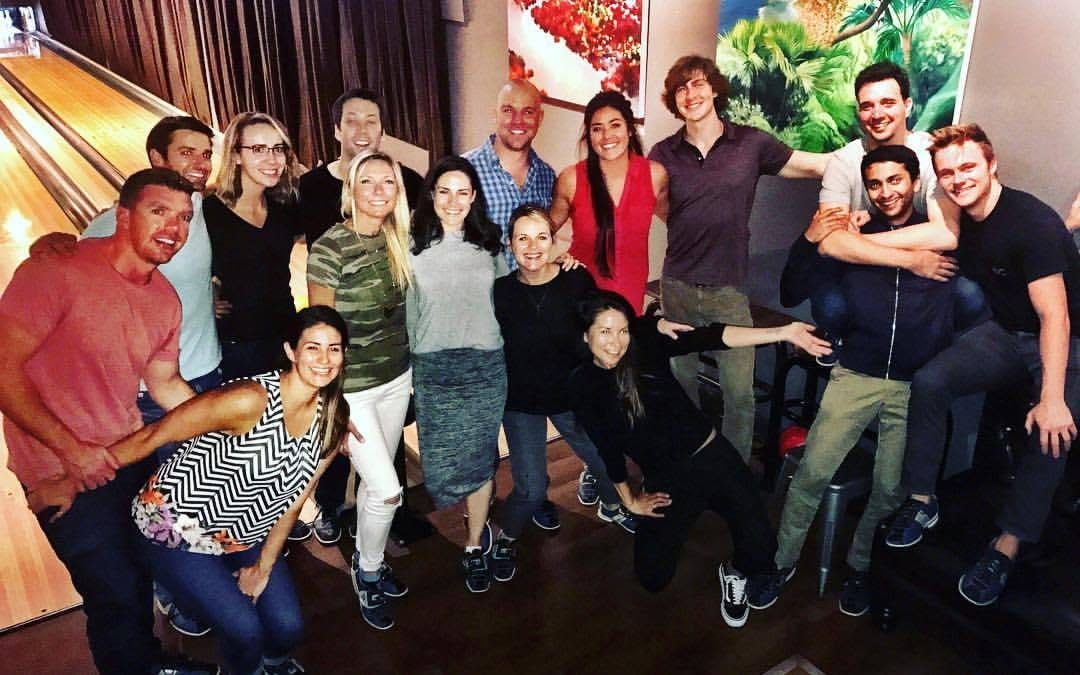
Eric Woersching remembers Alex as one of his funniest friends from Clarium: Vegas trips, poker and enough random hijinks that his preferred description is “artful dodger.”
Ben Verschuere remembers trips to Vegas too, sitting at blackjack tables for hours. He has always been struck by Alex’s appetite for risk, in trading and in games.
Eric remembers Alex as a free-market, libertarian sort of guy, interested in Milton Friedman and willing to argue about capitalism. He connects that conviction to the life Alex has lived, from a household with little money in Hamilton to Waterloo and Silicon Valley. Alex wants other people to make progress, Eric says. Eric values how independently Alex arrives at his views and how he keeps arguments focused on ideas.
Eric went to Alex’s wedding in Hamilton. It was also Eric’s first trip to Niagara Falls. He has watched Alex’s career change enormously while still recognizing the funny, opinionated friend he knew at Clarium.
Eric looks at 8VC as Alex’s masterpiece.
Vivek calls Alex the “wise dad” of 8VC’s younger investment group. Once someone has proved their competence, Vivek says, Alex is willing to work with them on everything. Vivek thinks venture is still fundamentally an apprenticeship business, and Alex treats it that way. Younger investors shadow him in meetings. They watch what he asks, what he ignores, where he pushes and where he lets a founder keep talking.
Vivek, Bela and Jack all began at 8VC as interns. They have spent years learning the job around Alex. He told me mentoring younger people gives him energy. He remembers how much other people helped him early in his own career: Oggie, Rosco, Joe, Peter and Ajay.
Jack says the firm’s size lets it hire people who fit well with the team. Alex has considerable freedom to choose the people he works with closely.
Alex once asked former Sequoia partner Pierre Lamond how he had known to hire Michael Moritz. Moritz had been a journalist. What had made him look like someone who could become a great investor? The answer Alex remembers is that Moritz asked good questions.
In his oral history for the Computer History Museum, Lamond recalled hiring Moritz with Sequoia founder Don Valentine. Moritz struggled at first, then recognized what he was doing wrong and improved. Younger investors learned by preparing for investment discussions and sitting in on board meetings.
Kevin Guo, co-founder and CEO of the AI company Hive, also interned with Alex. Kevin was drawn to Alex’s computer-science background and technical fluency. During diligence, Alex could assess how a product worked and whether it made sense as an investment. He kept making introductions and helping Kevin long after the internship ended.
Jack also babysits Alex’s kids. Depending on the day, he describes Alex as his boss, mentor, brother, uncle or dad. “Best career advice is who do you work for and can they help you succeed,” Jack told me. He would like to work with Alex for the rest of his career.
Alex does not coddle him. Jack says you cannot bullshit Alex. They do not have to talk constantly for Jack to know he cares. When something matters, he trusts Alex will do the right thing.
Bela describes working with Alex as a fight for focus. For her, that means building trust and winning him over. She has learned one way to get his attention: start a message with information about a public chip company or a new chip design, then put her ask below it.
Alex still follows public chip companies and their designs closely, Bela says. During our interview, he noted that investors expected memory to become a bottleneck.
Bela describes a running joke at 8VC: Alex can start out skeptical of someone and eventually decide they are one of his favorite people.
I met Sudarshan “Suds” Sridharan, general partner of SF1, at Backhaus in Burlingame on a sunny day. He showed up crushing a Celsius, young, hungry and full of energy. He has leaned on Alex for advice on building his fund as a business. Suds describes Alex “nerding out” over books most nights, often from nine until midnight.
Drew routinely invites Alex to speak at events. Alex tends to suggest Drew go instead. Drew calls him a “heat-seeking missile for substance.” He thinks Alex’s concentration on investing and his family helps explain why so many people have not heard of him.
Ajay called him “the quiet Canadian.” He brought it up unprompted, referring to H. Montgomery Hyde’s book The Quiet Canadian: The Secret Service Story of Sir William Stephenson. For Ajay, “getting shit done” is a rare skill. He describes Alex as capable and positive, someone who wants to make the world better. Ajay acknowledges the cliché, but thinks it fits.
Fatherhood made Alex more ruthless about his time. He says having children has not hurt his career. It has made him decide what deserves a place in the day.
Portfolio companies, people bringing him opportunities, family and close friends take most of his time. He tries to work out and has little time for other hobbies. He talks about putting a time limit on a deal and working toward a decision.
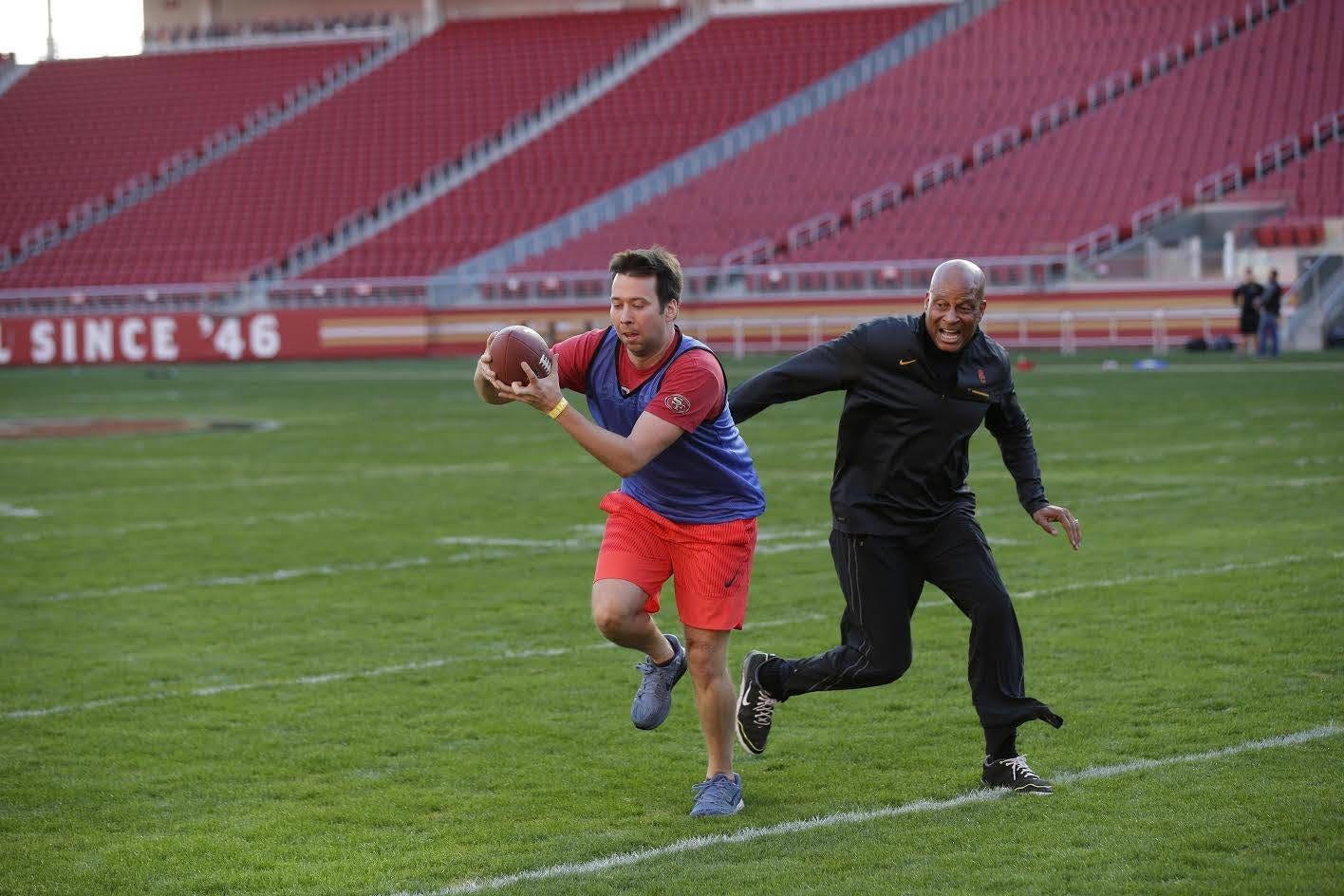
Alex still describes himself as a computer guy. San Francisco is where he wants to be. On an East Coast trip, he complained about the lack of constant talk about tech and AI. “Kinda sucks tbh,” he wrote. Michael Furlong remembers him staying stubbornly optimistic about San Francisco through the pandemic while friends moved to Austin, Miami or Marin. Alex kept arguing that it was worth fighting for. He stayed.
He ties some of that stubbornness to being Serbian. He says you fight for your home. During our conversation, he used the word sudbina. Fate. In his account, San Francisco has always moved through booms and busts, from the Gold Rush to AI. He wants to be here for what comes next.
Alex thinks AI is a generational moment. He told me being in San Francisco lets him see things sooner, from the researchers training models to founders experimenting with systems before they reach a broader market.
“People are not even seeing the best models right now,” Alex told me.
He says there are generations of better models that have not been released.
We talked about what happens to the value of being smart as machine intelligence improves. Almost everyone I interviewed had pointed to Alex’s intelligence. He is now backing companies that could make that ability far more common.
Alex has a joke about an investor betting his fund on artificial general intelligence, or AGI. If AGI makes intelligence cheap, the fund makes money. If the bet fails, the investor can still feel good about being smart.
He wants to find the next important AI company early, at seed, Series A or Series B. He told me each goal feels backward-looking as soon as he reaches it. The next company is more motivating. Having already found major winners has given him confidence to take bigger risks when the market, the team and the opportunity line up.
Alex brought up Matt Murphy at Menlo Ventures, who spent fifteen years at Kleiner Perkins before joining Menlo. His career already included AppDynamics and DocuSign when he led Menlo’s first investment in Anthropic in 2023, at a reported valuation of roughly $4 billion. More recently some Anthropic investors expect an IPO valuation of $2 trillion or more.
Murphy had been investing for more than two decades when Anthropic came along. Alex sees value in living through investment cycles and being ready to commit when a rare opportunity appears. Now in his early forties, he expects the next decade of his own career to be his most productive.
Alex and the team are now investing out of Fund VII, 8VC’s new $1.5 billion venture fund. It is backing companies across AI, defense, healthcare and industrial technology.
8VC is about ten years old. Bela says the ambition is to become a top-tier firm. Alex wants 8VC to be one of the top two or top five venture firms. He wants it to outlive him. When we talk about longevity, he brings up ancient civilizations and the things they built that survived them.
He told me the quality of the portfolio matters more to him than whether people think he is a great investor.
I keep thinking about the book Mackenzie brought into the boardroom. Alex had waited a long time for it, then flipped almost immediately toward the back. Four centuries of computing, and he wanted to know whether it included AI.
Alex wrote in 2024:
“Only the greats can persist through multiple cycles.”
Thanks to the following folks for sharing their time and stories and helping make this profile possible: Ajay Royan, Bela Becerra, Ben Verschuere, Boris Sofman, Chad Byers, Daniel Saks, Drew Oetting, Eric Woersching, Gaurav Jain, Harish Abbott, Jack Moshkovich, Jeffrey Morgan, Kevin Guo, Macenzie Walford, Matt Grimm, Michael Chiang, Michael Furlong, Oggie Nikolic, Paul Lee, Pete Florence, Ryan Gibson, Scott Wu, Sid Gupta, Sudarshan Sridharan, Trae Stephens, Vivek Gopalan.