

Most venture stories are supposed to start in the same few places: Sand Hill Road, a boardroom in New York, a founder’s cramped apartment in San Francisco.
This one starts on a beach path in Vancouver.
It is a beautiful Friday at the end of May, and I am walking with Boris Wertz along Kitsilano Beach. Across the water, downtown rises behind the marina. To the north, the North Shore mountains are still capped with snow. People are walking dogs, pushing strollers, drinking coffee, running along the seawall, and playing beach volleyball.
By conventional venture logic, this is not where the story should begin.
Not with one of the best-performing early-stage investors of his generation. Not with a firm that has backed Jobber, Clio, Ada, Coinbase, Uniswap, Dapper Labs, Shippo, Outreach, Headout, Moment Energy, Patch, EtherFi, and others. Not with a fund franchise whose earliest vehicles have produced the kind of returns most seed investors spend their careers chasing.
That is the strange thing about Version One, the firm Boris built and later shaped with Angela Tran. It has become one of the more remarkable small-fund franchises in venture while remaining unusually human-scale. Most of its funds have performed in the top quartile of their peers, with some in the top 10 percent. Coinbase alone returned 1.7 times the size of Version One’s second fund. The firm now manages more than US$300 million across its funds.
And yet the core investing team is Boris and Angela. There is back-office support behind the scenes, including CFO Leah Gosbee, who has worked with the firm for more than a decade and formally joined in 2021. It is still a no-frills team, but much of what Boris and Angela do is made possible by the work happening quietly behind them.
That contrast is the story.
At a time when many venture firms have become asset managers, platforms, content machines, and multi-stage institutions, Version One has stayed small. Its edge has not come from scale. It has come from judgment, proximity, and the ability to understand founders before the market understands their companies.
Version One calls itself an “underdog for underdogs.” It is a phrase that only really makes sense once you look closely at the work. The underdog, for Boris and Angela, is not the weak founder. It is the founder whose strength is not yet obvious to the market.
Walking along Kitsilano, that idea feels less like a slogan than the through-line of Boris’s career. Before he became an investor in overlooked founders, he had to build from outside Silicon Valley himself.
Boris Wertz grew up near Stuttgart, Germany, a region known for builders. His parents were pharmacists, and before he became known as a venture capitalist, Boris tried a series of entrepreneurial experiments of his own: raising snails, running a consulting business, and importing cars from North America to Europe.
After completing a PhD in logistics at WHU’s Otto Beisheim School of Management, Boris appeared set for a more conventional path. In 1999, he was supposed to join a German telecommunications company.
Then the internet got in the way.
“I had actually already signed something,” Boris said, “but suddenly this ‘internet thing’ exploded and became super interesting, with tons of traction, and I thought that I had to be a part of it. I told my future employer that I wouldn’t start the job. I assembled a team and found an idea or two we were excited about, which gave birth to JustBooks.”
JustBooks emerged after Boris had been working through several internet ideas and joined forces with what became a five-person founding team. The initial wedge was a student’s frustration: textbooks were expensive. The company started with used textbooks, then expanded into collectible, rare, and hard-to-find books. The bigger opportunity was aggregating fragmented supply from booksellers around the world.
In late 2001, JustBooks was acquired by AbeBooks, its North American equivalent based in Victoria, British Columbia. Boris and Hannes Blum stayed on and moved to Victoria to help run the company.
Hannes had first met Boris at university in 1998. They shared an apartment, and Hannes remembers a small detail that now feels revealing. Hannes would usually wake up around 8am. Boris would already be at his computer by 6:30am, booting it up to the faint beeping of dial-up. That intensity followed him into AbeBooks.
AbeBooks had difficult moments, as all companies do. Hannes remembers one recapitalization when others were selling shares. Boris’s reaction was the opposite: “Whatever anyone is selling, I am buying.” It was an early sign of a trait that would later define him as an investor. When Boris had conviction, he was willing to lean in while others hesitated.
By 2008, AbeBooks was doing several hundred million dollars in annual transactions and had built a global database of 100 million books. Amazon acquired the company for a reported $110 million. Boris reportedly netted about $5 million from the acquisition.
But the more important thing AbeBooks gave him was not just capital. It was a worldview. Years inside AbeBooks taught Boris how marketplaces actually work: how to spin up supply and demand, how market structure shapes outcomes, and how difficult it can be to balance a passionate community with the needs of a company.
Boris did not become a marketplace investor because marketplaces became fashionable. He had already lived inside one.
After the Amazon sale, Boris was not ready to start another company. But he also was not ready to leave startups. Angel investing became a way to stay close to the earliest, messiest part of company-building while he figured out what his next chapter would become.
The name he chose for that vehicle, W Media Ventures, now feels revealing. When I asked him about it on our walk, Boris’s explanation was simple: media was interesting to him at the time. He was still drawn to consumer internet, online communities, and the ways people were beginning to gather, publish, transact, and build identity on the web.
For a while, that meant being more than an investor. One of those chapters was Nexopia, the Edmonton-born youth social network, where Boris served as CEO after Acton Capital became involved with the company. The bet, as Boris described it, was that regional social networks might win. They did not. Facebook did.
GrowLab carried a similar lesson. Boris helped start the Vancouver accelerator, which later merged with Toronto-based Highline. It was an attempt to build a startup accelerator in Canada at a moment when accelerators were becoming an important part of the early-stage ecosystem. But that market, too, ultimately had a global centre of gravity. Y Combinator became the dominant platform.
On our walk, Boris talked through these experiences almost as a thought exercise. Again and again, he had been close to a local, regional, or category-specific version of something that would later be defined by a global platform. AbeBooks was acquired by Amazon. Nexopia was beaten by Facebook. GrowLab was overtaken by YC. None of those experiences maps perfectly onto the next, but together they seem to have sharpened a question that would follow him into investing: when is a company a strong local play, and when can it become a global platform?
That question has shaped Version One, whether intentionally or not. The firm kept looking for founders outside the centre, but became more demanding about what those founders could become.
From 2008 to 2012, he invested under the moniker W Media Ventures, making roughly 35 angel investments. That period gave him confidence that he could help founders and that he understood how to invest. Among those early angel investments were Unbounce, Wattpad, Indiegogo, and Indochino. He tallied six exits while building a reputation as an active investor and trusted partner for first-time entrepreneurs.
“We’re maybe later-stage than most,” Unbounce co-founder and CEO Rick Perreault said at the time. “But I meet with Boris regularly because he’s got a great global perspective and always has good advice.”
There was also Acton Capital. Boris was a venture partner at Acton when the firm invested in Clio’s Series B, a detail Jack Newton remembers as part of Boris’s early connection to the company. Christoph Janz met Boris through Acton, and Boris’s role there became part of the bridge between his angel investing years and the formal launch of Version One.
In 2012, Boris decided to take the next step. He transformed W Media Ventures into a full-fledged venture capital firm: Version One Ventures. Fund I was a US$18.7 million fund backed by people including Jeff Mallett, the former president and COO of Yahoo; Ryan Holmes, the founder of Hootsuite; Markus Frind, the founder of Plenty of Fish; and Sam Znaimer.
Markus Frind met Boris in March 2012.
“He talked like an entrepreneur, and I felt like he could spot the trends,” Markus told me. “It was actually my first VC fund investment. At the time, I was still doing Plenty of Fish, and I was starting to diversify into other things.”
Sam Znaimer remembers having lunch with Boris in Vancouver around the same time. Boris was looking to meet other venture investors. Sam was attracted to his energy and entrepreneurial success, but also to the fact that Boris was already thinking about venture differently. Sam was used to funds that would agonize if a company went to zero. Boris was looking for companies that could return 100 times the money.
That was the beginning of Version One as an institution. But in many ways, it was simply the formalization of what Boris had already been doing: finding founders early, leaning into markets others did not yet understand, and trying to be the kind of investor a founder could actually use.
It also helps explain why Version One was never simply a Canadian venture fund, even though it was built in Vancouver and many of its defining early stories were Canadian. Boris had learned too many times that technology markets do not reward provincial thinking for long. A company might start in Germany, Victoria, Edmonton, Toronto, Vancouver, Seattle, or Bangalore, but the question was always larger than where it began. Could it become important everywhere that mattered?
That became one of Version One’s quiet advantages. Boris was physically outside the centre, but not intellectually provincial. Angela would later give the firm a deeper presence in Silicon Valley, but the instinct was already there: the best companies could come from anywhere, but they still had to matter everywhere.
Angela Tran’s path to Version One began in a different place, but with a similar pattern: a non-obvious person finding her way into a non-obvious role.
Angela was born and raised in Toronto. Her mother was a Vietnamese refugee, and her father a Vietnamese immigrant. Both arrived in Canada with little more than the clothes on their backs.
“They worked hard for everything,” Angela has said, “which pushed me to be the best version of myself. They instilled in me the value of education and hard work.”
Her father, Honghi Tran, became a world-renowned Professor Emeritus of Chemical Engineering at the University of Toronto and a leading expert in the pulp and paper industry. Angela, affectionately known as Ange, also attended the University of Toronto, spending nearly a decade there as she worked her way from a bachelor’s degree toward a doctorate in applied science.
Bram Sugarman went to high school with Angela. They took many of the same classes, and because Tran and Sugarman were close in the alphabet, they often found themselves near each other. Angela even copied some of Bram’s old computer science coursework. When she later thought about quitting computer science, Bram was the one who told her not to. He called her Angel.
In the middle of her PhD, Angela moved to Silicon Valley. It was a jarring shift.
“The move was very eye-opening for me,” she has said, “because before that, I had lived my whole life in Toronto in a small, four-kilometre radius. I arrived in Silicon Valley with no idea of what to expect, but the attitude of, ‘Hey, I have an engineering degree, how hard is it going to be for me to get a job?’”
After a few interviews, she quickly realized it would be harder than expected. She knew how to code, but not in a production setting. In the meantime, she began tapping the University of Toronto network for connections to other people in Silicon Valley.
One of those connections was Yuri Sagalov, now Managing Director at General Catalyst. Yuri introduced Angela to a friend of his, Jake Klamka, who was starting a company called Insight Data Science. Angela would end up helping co-found it.
Insight was built around a timely idea. Data science was becoming one of the most important new functions inside technology companies, but many of the people best suited for the work were coming out of academic environments, not industry. Insight trained top PhD students and other STEM researchers to become data scientists, then helped place them at companies like Facebook, LinkedIn, Google, and Twitter.
The company received funding from Khosla Ventures and Y Combinator. Angela spent about a year and a half building Insight. But after running multiple cohorts, she realized she did not feel the same pull toward the business that her co-founder did. Jake was deeply passionate about continuing to build Insight. Angela was looking for something else: a place to keep learning, to work on ambiguous problems, and to have freedom.
That next chapter came through another Canadian. Around that time, Angela met Brendan Baker, then an operating partner at Greylock. Brendan interviewed her for a role at the firm, and the two bonded over ultimate frisbee and being Canadian. Angela did not get the Greylock job. Kevin Kwok ultimately did.
For many people, that might have been the end of the story: a near miss at one of Silicon Valley’s great venture firms, followed by a return to whatever came next.
A few months later, Brendan reached back out. A friend of his in Vancouver was looking for an analyst. His name was Boris Wertz.
Brendan knew both sides of the equation. He had long thought highly of Boris, who he describes as “one of the OGs of early-stage investing in Canada.” The two knew each other through Vancouver. He had also met Angela while he was at Greylock and had come away impressed.
“I knew Boris wanted to grow the team, so I connected the two of them,” Brendan told me. “I thought they’d be a nice fit, but the length and depth of the partnership have even exceeded my expectations, and they’ve done a great job shepherding Version One.”
Angela did not know much about venture capital, which in retrospect may have been part of the fit. Venture was not yet the polished career track it has since become, full of former bankers, consultants, operators, and people moving through increasingly well-marked paths. Back then, as Angela remembers it, the industry still had more room for misfits. The work was ambiguous and hard to structure. There was no obvious playbook for what made someone good at it. Angela was not looking for status in venture. She was looking for a place where she could keep learning and think freely.
She and Boris first spoke over Skype in July 2013. Two weeks later, they met in San Francisco. Boris gave her a simple assignment: find two or three companies that would be a good fit for Version One.
Angela responded the way a technical person might. Instead of relying on intuition or warm introductions alone, she tried to build a model. She pulled from Twitter, LinkedIn, Crunchbase, and whatever other data she could find, trying to predict which companies were most likely to succeed. But the data did not cooperate. It was incomplete, underreported, inconsistent, and messy. The deeper she went, the less clean the answer became.
By the time she met with Boris again, she did not have a polished list of companies. She had something stranger and probably more revealing: an explanation of why the model had failed. Almost every company looked like it was going to fail. The signal was not obvious enough. The work resisted the structure she had tried to impose on it.
It was, in its own way, a perfect introduction to venture capital. Angela had entered the process trying to make the work legible. What she found was a business where the most important decisions often had to be made before the evidence was complete. That did not mean the work was unserious. It meant the opposite. The ambiguity was the work. You could bring rigour to it, but you could not reduce it entirely to a model.
Angela now describes that first failed model less as an embarrassing detour than as the beginning of her real education in venture. Boris, she says, helped her understand that early-stage investing is “100% about founder quality” rather than the credentials and signals that show up neatly on a LinkedIn profile. That was why her first “moneyball for VC” approach did not work. It could gather data, but it could not fully see the person.
The lesson stuck. In a later reflection on her first four years at Version One, Angela wrote that early-stage success was hard to predict because the data was incomplete, inconsistent, or unavailable, and because outlier companies are, by definition, hard for models to identify. The more useful question was not simply whether a company looked promising in a dataset. It was whether the founder had the qualities that could turn ambiguity into progress: hunger, ambition, craftsmanship, storytelling, and the ability to learn quickly.
Before committing, Angela did her own diligence on Boris. One of the people she reached out to was Bram Sugarman, who at the time was at OMERS Ventures. Bram was not just another investor in her network. He and Angela had grown up together in Toronto. They had gone to high school together, taken many of the same courses, and become close friends. When she wanted a read on Boris, Bram’s reply was short and useful: Boris was solid.
Angela still did not fully understand why Brendan had brought her and Boris together in the first place. Later, she asked him. Brendan had seen Greylock’s process up close and had his own read on her fit. Angela, he told her, would have been bored at Greylock. Version One was better suited to the way she wanted to learn and work: closer to the edge, more ambiguous, less institutional, and more directly tied to the earliest stages of company formation.
For Boris, hiring Angela was a real bet. She had no conventional venture experience and no investing track record. But she had something that mattered more for the kind of firm Version One was becoming: curiosity, rigour, independence, and comfort operating in the grey. In a business built around finding non-obvious founders before the market understood them, Boris’s decision to bring Angela into Version One was itself a kind of non-obvious investment.
One of the first pieces of validation came through Shippo. Albert Wenger, managing partner at Union Square Ventures, had mentioned the company to Boris, and Angela, who admired him, paid attention. Shippo gave her an early chance to test the instincts she was developing inside Version One: how to diligence a young company, how to think about a founder, and how to work through a market that was still taking shape.
That pattern would repeat. Angela’s work at Version One was never just about finding companies. It was about building judgment alongside Boris, in close proximity to founders. Boris brought her into calls, shared context, talked through passes and investments, and gave her access to the full texture of the job. What began as a non-obvious hire slowly became something more important: a partnership built through repetition, trust, and a shared way of seeing people before the market did.
A lot of firms talk about partnership. At Version One, partnership became a daily practice.
In the early years, Boris brought Angela into everything: portfolio calls, founder meetings, internal conversations, passes, debates, the full texture of how he worked. They spoke every day. They still do. Over time, the firm became not just an extension of Boris’s judgment, but an ongoing conversation between two people who shared a way of seeing founders.

They talk about speed, clarity, and the sense that Boris and Angela do not waste time. Edward Chiang of Moment Energy remembers Angela using “we” instead of “you,” a small linguistic shift that made the process feel collaborative rather than extractive.
Danielle Strachman from 1517 Fund has worked with Angela on a number of investments and describes her as “super decisive, clear, and feedback-oriented with founders.” It is a small quote, but it captures something founders and co-investors repeatedly mention: Angela brings clarity to the messy, ambiguous earliest stages.
Mike Murchison describes Boris as an unusually strong synthesizer and sounding board. He says he can bring Boris extreme complexity, and Boris will distill it into three actionable points. That ability still matters years later, even after Ada has grown into a much larger company. It is a different kind of board value than pattern-matching or network access. It is judgment under complexity.
David Hariri describes Angela’s support in a similar way. What stood out to him was not just that she checked in, but that the check-ins never felt like portfolio maintenance. They felt like someone who understood the loneliness of building and still wanted to know what was actually happening underneath the surface.
Yuri Sagalov, who had known Angela since her earliest Silicon Valley days, sees another version of the same thing. Boris spends most of his time in Vancouver. Angela became the face of Version One in the Bay Area. Yuri says he and Angela have shared deals and co-invested over the years, but he describes the relationship first as personal. Angela is a dear friend before she is a venture investor. That distinction matters because it mirrors how Angela seems to operate with founders too: close, personal, high-trust, but still serious about the work.
The point is not just that Boris and Angela work well together. It is that Version One itself became the product of that working relationship.
That is unusually literal. Version One is not a platform with layers of partners, principals, associates, scouts, operating partners, and brand machinery. The daily syncs, founder calls, portfolio work, category theses, fundraises, and judgment all run through a small team built around Boris and Angela.
The phrase Version One uses is “underdog for underdogs.” It risks sounding tidy until you look closely at the portfolio.
The underdog, for Boris and Angela, is not the weak founder. It is the founder whose strength is not yet obvious to the market.
In practice, that has meant mission-driven founders working in early, misunderstood markets: vertical software before much of Canada believed in category-defining SaaS companies, marketplaces before the playbook was obvious, crypto networks before the incentives were widely understood, and now areas like robotics, biology, AI infrastructure, and India before consensus capital has fully formed around them. Version One is not looking for underdogs as an identity. It is looking for founders whose ambition, timing, or market may be misunderstood before they become obvious.
Jobber in Edmonton. Ada in Toronto. Clio in Vancouver, resisting pressure to move south. Moment Energy coming out of Simon Fraser University and a garage. Patch raising from Version One with five slides and essentially no traction.
There is a pattern there, but it is not charity. Version One is not backing overlooked founders because overlooked is virtuous on its own. It is backing them because the market often misprices the earliest signs of ambition.
A company can look too local before it becomes global. Too niche before it becomes a category. Too technical before the customer is obvious. Too operational before the infrastructure is built. Too early before the market has language for what it is becoming.
That is where Boris’s “n of 1” idea becomes useful. He does not talk about venture as a linear business. The world, as he sees it, is exponential. The best companies do not become slightly better versions of existing companies. They become singular. At the beginning, those companies can look strange because there is nothing clean to compare them against.
Clio belongs in that story, but more as context than centrepiece. Boris had already been connected to one of Canada’s defining vertical software companies through Clio. While at Acton, he invested in Clio’s Series B, and Version One later invested alongside Bessemer in the Series C. Jack Newton first met Boris through Christoph Janz while looking for introductions to Silicon Valley investors. Instead, Boris became interested himself.
The first meeting was at a Cafe Artigiano in downtown Vancouver. Jack remembers Boris as intensely curious and sharp. More importantly, Boris could get behind the idea of building a world-class company from Vancouver at a time when many Valley investors were pressuring Clio to move south.
That was the useful thing about Boris in those years. He had global perspective without assuming great companies had to leave Canada to matter.
Version One’s first major focus was shaped by marketplaces and vertical SaaS. That was not random. Boris had lived the marketplace problem at AbeBooks, and the early portfolio reflected the questions he understood best: fragmented supply, underserved categories, trust, liquidity, and software that made specific industries work better.
Boris later turned those lessons into A Guide to Marketplaces, a framework for thinking through the sequencing problems that define marketplace companies. Marketplaces were not just websites with buyers and sellers. Which side do you attract first? How do you create liquidity before the market is liquid? When do you subsidize supply? When do you constrain demand? How do you know whether you are building a marketplace or just forcing two sides together?
Those were the kinds of questions Boris had lived inside at AbeBooks, and they became the kinds of questions Version One asked in companies like Shippo, Headout, and eventually crypto networks. When the firm cared about a category, it did not just chase deals. It built a way of thinking.
Few companies capture early Version One better than Jobber.
When Sam Pillar and Forrest Zeisler were building the first version of the product in Edmonton in 2011, they were not obvious venture-backed founders. They were not in Silicon Valley. They were not even in one of Canada’s more developed startup markets. They were building software for home-service businesses: plumbers, landscapers, cleaners, contractors, and the small operators who ran much of the physical economy but had been largely ignored by modern software.
At the beginning, Sam did not really know what venture capital was. Jobber was not born inside a mature startup ecosystem. Sam had written an intricate business plan, but the bigger ambition had to be pulled out of him.
So Sam started learning. He researched venture capital online and posted Jobber on startup listing sites. That was how Point Nine Capital first found the company. Christoph Janz reached out from what Sam remembers as a German Hotmail address, a detail that captures how unlikely the whole thing felt at the time.
There was a small echo of Clio in that detail. Christoph had also found Clio early and reached out in a similarly lightweight way, before most people understood what a vertical software company from Canada could become.
Forrest was living in Vancouver then and had been meeting people in the startup community. At one event, he met Boris Wertz and told him what he and Sam were building. Boris and Sam were connected by email, and Sam flew to Vancouver to meet him at Boris’s old office on Water Street. A few of Boris’s companies were working out of the office at the time. It felt less like a formal venture firm than an early-stage workshop.
Sam remembers Boris as one of the earliest of the earliest investors, the “first money in guy.” The meeting went well enough that Sam came back again for what felt like the real meeting. By the time he landed back in Edmonton, Boris and Christoph had sent a term sheet.
The first investment was $250,000 CAD on a $1 million CAD pre-money valuation.
For Sam, that felt incredible. A year later, Jobber raised another $500,000 from the same group. A year after that, it raised another $1 million. In total, Boris, Christoph, and that early group put about $1.75 million CAD into the business across those first rounds.
In hindsight, the numbers are almost hard to process. The first cheque went into a company valued at roughly $1 million Canadian before the new capital. Today, according to Sam, Jobber is doing north of $350 million in revenue. Even at a conservative 8 to 10 times revenue multiple for a durable SaaS business, that implies a company worth billions of dollars. The distance between those two numbers tells the story of early-stage venture when it works: a company that once looked too small, too local, and too niche becomes one of the most valuable software businesses in the country.
But the money was only part of what mattered. Boris and Christoph helped Sam and Forrest learn how to build a real software company. They pushed the founders to think bigger, but also more rigorously: KPIs, churn, cohorts, metrics, and the operating discipline behind a durable business. This was not a blitzscaling story. Build something valuable. Build something lasting. Build something that could endure.
Sam says Boris contributed to his business education. He also notes that Boris was figuring things out, too. Some of the earliest Jobber investments happened around the transition from Boris’s personal angel investing through W Media Ventures into Version One Fund I. Jobber was not only an early proof point for Version One. It was one of the companies that helped shape what Version One would become.
Around 2015, Jobber raised its Series A from OMERS Ventures and held its first formal quarterly board meeting in Edmonton. All the board members came in. Boris asked if he could bring his child because he wanted to show him what an amazing company looked like. He even prepped him with questions.
Sam found that revealing. Boris was smart, driven, and deeply business-minded. But he also cared a lot about family. He wanted his child to see company-building up close.
Later, Jobber received an acquisition offer for around $20 million. For Sam and the team, it would have been meaningful. Sam remembers that they could have walked away with millions. For many first-time founders, that is life-changing money.
It was also the kind of moment where investor incentives can distort the room. Boris sat Sam down and made the dynamic explicit. This was Sam’s company. He had built it. If he wanted to sell, there would be no judgment. But if he wanted to keep going, Boris wanted him to understand there would be more work ahead, and that Version One would be behind him if he chose to do it.
That moment says a lot about Boris’s style. He did not treat the founder as a pawn in the fund’s game. He gave the decision back to Sam.
Jobber kept going.
That decision looks different now.
In retrospect, the story looks almost too clean as a Version One archetype: Edmonton, vertical SaaS, non-obvious market, first-time founders, early capital, repeated support, patient company-building, and a founder given the autonomy to choose the harder path. But in real time, very little about it was obvious. That was exactly the point.
Shippo showed another side of the first Version One act.
If Jobber was the vertical SaaS bet from Edmonton, Shippo was closer to the marketplace pattern Boris understood from AbeBooks. Laura Behrens Wu saw Boris not just as another investor, but as the marketplace expert. That mattered because Shippo was not an abstract software company to him. It was the kind of company where the hard questions were familiar: how do you aggregate fragmented supply, create trust, build liquidity, and make a network useful before it is obvious to everyone else?
But what Laura remembers most is not just Boris’s expertise. It is his posture.
Boris, to Laura, was a founder before he was a finance person. That difference came through in how he listened, how easy he was to talk to, and how clearly he seemed to be on the founder’s side. Laura felt that Boris was actually listening, not simply absorbing the loudest opinion in the room or falling under the spell of other board members. He had intellectual curiosity, but also founder empathy.
When Shippo later needed bridge financing, that posture mattered. The company was not in a position of strength. Those are the moments when investor behaviour becomes revealing. Laura remembers Boris as loyal, hardworking, and firmly on her side. He and another investor stepped up on good terms. They did not use the company’s weakness as an opportunity to take advantage. They built conviction and leaned in.
Over time, the relationship continued beyond that moment. Laura still checks in with Boris. And through the company, Laura and Angela also became close. Angela showed an ability that founders rarely forget: she could become a real friend while still knowing how to compartmentalize the founder-investor relationship.

It was not just that Version One knew marketplaces. It was that the founders in those marketplaces felt the firm knew them.
Early-stage investing often becomes most revealing when the first plan fails. Anyone can say they back the founders when the company is working. The harder question is what happens when the company is not.
For Mike Murchison and David Hariri, the company before Ada was Volley, a social search community for feedback on niche challenges. Version One had led the pre-seed round. But eventually, despite early growth and a product people liked, the founders could not figure out how to scale it beyond a few local markets or what the long-term business model should be.
For Mike, the realization felt like failure. He was young, and Boris was his main investor. He decided to tell him over lunch in Toronto at Fresh on Spadina. He was so nervous that he wrote out a speech, printed it, and brought it to the restaurant.
Boris was already there when he arrived. The waiter came by to take their order. Mike could not eat. Boris ordered coffee and a salad. Then Mike pulled out the paper and began reading. He wanted to explain what he had learned, why Volley was not working, how sorry he was, and that he would understand if Boris wanted his money back.
Boris took the paper out of his hand, pushed it aside, and asked a simpler question.
What are your ideas?
That changed the meeting. Mike started talking about what the team had learned from building Volley. One of the biggest challenges was customer service. Most companies, he believed, were thinking about customer support the wrong way. They were focused on reducing customer conversations, not increasing them or making them more useful.
Boris did not treat the moment like a post-mortem. He treated it like the beginning of the next company. In that same meeting, he made an introduction to someone at Shopify, who would become one of Ada’s first customers. A lunch Mike had entered as an apology became one of the first steps toward the company Ada would become.
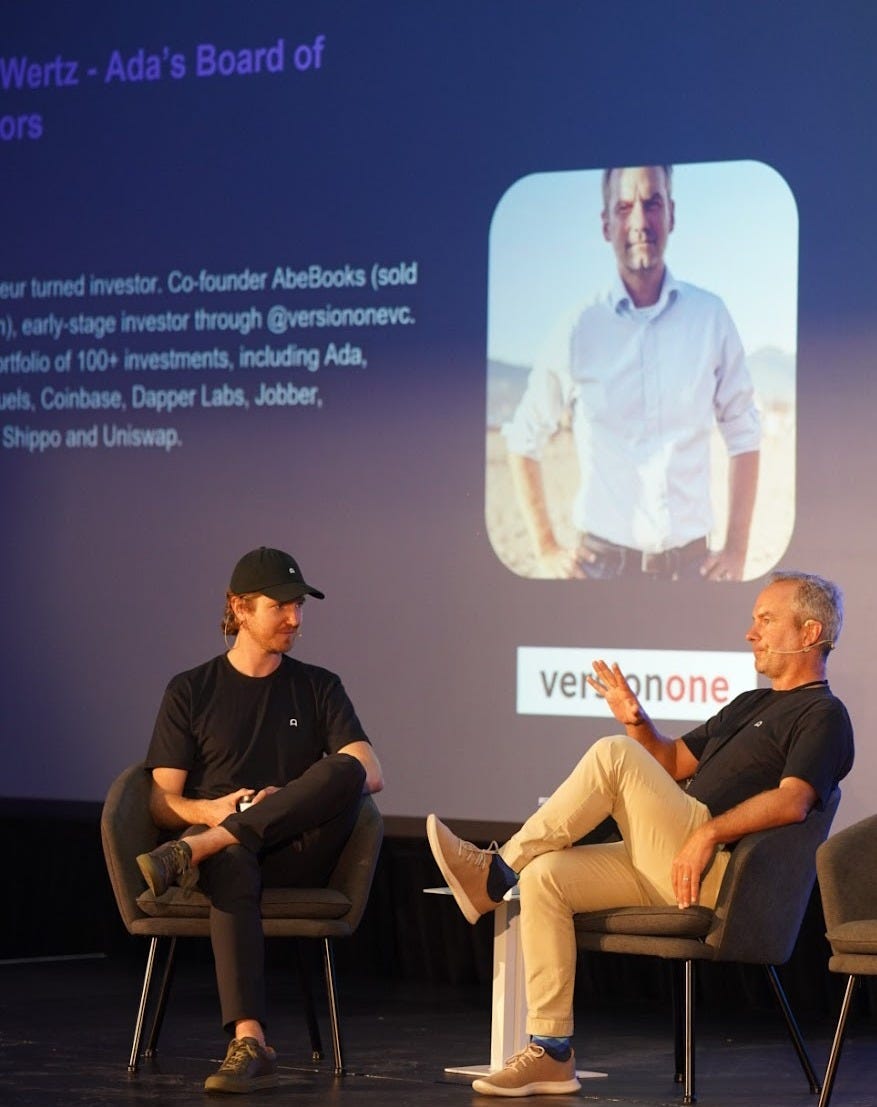
David remembers the same period from another angle. To him, the natural assumption was that winding down Volley meant returning whatever capital remained, so the investment was not a total loss. He remembers agreeing with Mike that this was the right thing to offer. Boris saw it differently. David’s recollection is that, without hesitation, Boris told them not to give the money back. Figure out what is next quickly.
That sentence changed the meaning of the moment. Volley’s failure did not have to become the founders’ failure. The remaining capital was not salvage value. It was permission to keep going.
David is unusually clear about how much that mattered. If Boris had accepted the remaining cash, he says, Ada probably would not have happened. The founders would have gone through the process of winding Volley down. They would have needed another source of income. David might have gone back to agency work or taken a job somewhere like Shopify. Instead, Boris’s response washed away some of the guilt, shame, and failure that can attach itself to an early startup that does not work. It gave the founders both the emotional permission and the practical runway to search urgently for the next thing.
That next thing became Ada.
Angela’s point about founder quality becomes easier to understand through Mike. Publicly, Mike has described a serious head injury at 19 and being told by physicians that he would not realize his potential. He has said the experience created a competitive drive to prove people wrong, a thirst for self-improvement, and a desire to do hard things. That context matters because Version One was not just underwriting a customer-support idea or a conversational AI company. It was underwriting a founder who had already built a habit of turning doubt into fuel.
Mike describes Version One as the most authentic and people-forward firm he has ever worked with. To him, Boris and Angela put their belief in the individuals ahead of their belief in the market, project, or startup the team happens to be working on at the time.
That is not just an idea in Ada’s history. It is part of why Boris has stayed close for so long. He was the first check into the company that became Ada and has remained on the board through the company’s many periods of growth and change. Mike says that is extremely rare for a pre-seed investor. It is also, to him, a reflection of the quality of partner Boris has been.
Mike also points to how long Version One stayed in the investment. Boris and Angela were not just early. They were long. They doubled down through the company’s later rounds in a way Mike says very few investors do. Founder-first investing can sound sentimental until it is tested by time, dilution, and the opportunity to keep concentrating behind the company. Version One kept showing up.
Angela’s role in the Ada story was different, but just as important. David remembers first meeting Angela when she came to Toronto to do diligence on Volley. The diligence was not vague. It was specific and analytical. They sat in a coffee shop and went through the production database, running SQL queries and trying to understand what was actually happening in the product. David remembers feeling intimidated and excited by someone who cared as much as he did about numbers and ground truth.
That became one of Angela’s signatures. She could support founders emotionally, but she was not just there to be empathetic. David saw her as deeply capable in business strategy, technical strategy, and the hard analytical questions that founders often have to face alone. In the Volley days, she helped think through whether the product was working, what business models might support it, and when it was time to stop. As David put it, deciding when to stop working on something can be harder than deciding when to start.
Years later, when Ada had become a much larger company, the relationship did not disappear into portfolio management. Angela would still message David periodically to check in, sometimes monthly, sometimes quarterly. It never felt transactional to him. It did not feel like a CRM reminder. It felt like someone who genuinely cared about the founders as people and understood how lonely building a company could be.
Boris’s relationship with David had its own version of that. On one visit to Vancouver, David messaged Boris to say he was in town. The two went for a run near Boris’s home, through the beach and forest. They did not talk much about Ada, if at all. It was not profound in any obvious way, but that was the point. David had never done that with another investor, and he did not think he would want to.
That is what makes the Ada story important. It is not only a story about a strong investment. It is a story about what Version One’s founder-first language looks like when it has to survive failure, uncertainty, and time. Boris believed before the next company existed. Angela helped the founders find ground truth when the first one was breaking. Both stayed close long after the easy narrative had formed.
Outreach belongs in the story as a shorter echo of the same pattern.
The company did not begin as Outreach. Manny Medina and his co-founders had first been working on a recruiting marketplace after meeting through Techstars in 2011. The idea struggled. Inside the company, however, the team had built an internal email tool to manage their own outbound process. Boris saw that tool differently. According to the founder story, he encouraged the team to sell the internal product rather than continue forcing the original marketplace idea. He and another investor also helped bridge the company, giving the team enough time to make the turn.
That became Outreach.
The details are different from Ada, but the instinct is familiar: a first idea that was not working, a founder still worth backing, a product hidden inside the company’s own workflow, and an investor willing to help the team move toward the thing that was actually pulling. Outreach later became one of the defining software companies in the sales technology category and one of the major drivers of Version One’s first fund.
Crypto looks like a departure from marketplaces only if you miss the underlying logic.
For Boris, the connection was not hard to see. Tokens, exchanges, staking networks, NFT platforms, and decentralized protocols all carried versions of the same questions marketplaces had always asked: how do you bootstrap participation, create liquidity, align incentives, and give users a reason to join before the network is obviously valuable?
That is why Version One’s crypto work should not be written as a sudden thematic pivot. It was a new expression of an old instinct.
Coinbase became the most obvious proof point. Version One invested from its second fund, a fund small enough that a single breakout could change the trajectory of the entire franchise. Version One invested US$2 million across Coinbase’s 2017 and 2018 rounds. By the time Version One distributed those shares to its investors, they were worth 1.7 times the size of the entire fund.
But the more revealing crypto story may be Mike Silagadze.
Mike first met Boris years earlier at a Bay Area event in Sonoma or Napa. At the time, Mike was building Top Hat. He pitched Boris on the company and was drawn to the fact that Boris had been an operator before becoming an investor. Boris was not just thinking like a finance person. He was a product person. He had useful views on the business model, and after a follow-up call, he invested in Top Hat’s Series A.
It was a competitive round, but Mike wanted Boris involved.
That relationship continued long after the cheque. Mike called Boris for advice on product, recruiting, and company-building. Boris was available, founder-friendly, and unusually easy to talk to. With some investors, Mike felt he had to polish the update before bringing it to them. With Boris, he did not need the filter. He could use him as a sounding board while the thinking was still messy.
That mattered later, when Mike moved into crypto.
Mike knew Boris had become active in the category. Version One had already had success with Flow and Uniswap, and Boris was bullish on crypto before it became obvious to much of the market. When Mike began working on what would become EtherFi, he sought Boris out again.
At first, the company was not yet EtherFi. Mike was starting a hedge fund called Gadze Finance. Boris wrote the cheque largely because of the relationship. It was a founder bet before it was a fully formed company bet.
Then FTX collapsed.
Gadze had exposure to FTX, and the fund took a loss. Mike was devastated. He felt responsible for protecting investor capital and sent an email implying that they would likely shut down the fund. For many investors, that could have been the end of the relationship. The category was under pressure, the structure had changed, and the story no longer looked like the original pitch.
Boris reached out and was supportive. The message Mike remembers was simple: “We are still here to back you.”
That gave Mike permission to keep going.
When Gadze Finance evolved into EtherFi, Boris and Version One re-upped. The company that emerged was not the hedge fund Boris had first backed. It was a new expression of the founder’s conviction in crypto and in the infrastructure that could sit around it.
That matters because crypto tested the same thing marketplaces and software had tested before it: conviction through volatility. It is easy to say tokens are a new way to bootstrap networks. It is harder to keep believing in a founder when the whole category is under pressure and the market has turned hostile.
The relationship also shows another part of Boris’s style. Mike says Boris is willing to roll up his sleeves and help, not just with the CEO, but with the broader team. Other members of the team will reach out to him directly. He is not always in the same city, so they do not meet in person often, but the relationship still works because Boris is useful without requiring the founder to perform.
The Coinbase return proved the market thesis. The EtherFi story shows the founder thesis.
In crypto, as in marketplaces, Version One wanted to be early enough that conviction still mattered.
Moment Energy shows what Version One’s model looks like in a newer, hard-tech category.
When Edward Chiang first got to know Boris in 2020, he was still a recent Simon Fraser University graduate, and Moment was being built in a garage. They were not fundraising yet. They were just getting to know each other. A year later, when Edward came back to raise, the process moved quickly.
He spoke with Angela first for 30 to 45 minutes. What stood out was not just the questions she asked, but the way she framed them.
Angela’s work with founders often starts before the company is fully legible. She spends time trying to understand not just the market or the product, but the person behind it: what they have overcome, why the work matters, and whether the ambition is rooted deeply enough to survive the hard parts. The specifics are not always public, and often should not be. But the pattern shows up across the portfolio. Angela is not only asking whether the company can work. She is asking whether the founder has a reason to keep going when it does not.
Angela used “we” instead of “you.” To Edward, that small shift made the process feel collaborative. It did not feel like an investor evaluating a founder from a distance. It felt like someone beginning to work through the company with him.
That was not just a stylistic difference. Edward describes Angela as “the hardest working person I know.” He says her superpower is business-building: hiring, process, scale, and helping a young technical founder build the company around the product.
Then came a call with Boris and Angela together, then a 45-minute call with Boris the next day. Edward happened to be going to Palo Alto that weekend, so he met Angela for breakfast. Angela was pregnant at the time. Edward still remembers the speed and intensity of it.
At breakfast, Angela offered a term sheet.
All of it happened within a week. Version One led the round. Edward had set out to raise $2 million and ended up raising more than $3 million. Angela introduced Moment to more than eight investors, and all of them invested. Other investors trusted her judgment.
The relationship did not stop with the round. Angela helped Moment grow from eight people to seventy-two. Boris and Angela did not pretend to know everything, which mattered too. They knew where they could help, and they leaned in there.
By the time Angela stepped off the board at the Series B, the relationship had become more than professional. Edward now considers her one of his closest friends. She was the only investor he invited to his wedding.
For Edward, Boris and Angela did not just fund a company. They helped give him the room to work on his life’s work.
Patch shows the same model at its purest early-stage edge.
When Brennan Spellacy raised the company’s pre-seed, Version One led the round. The financing was $1.2 million, and Version One wrote $600,000. Angela led the investment, with Boris involved in the process. The company had five slides and essentially no traction.
To Brennan, that mattered because very few funds still behave that way. A lot of large venture firms talk about investing early, but pre-seed has become a process for many of them: a way to track companies, build option value, and wait for more signal. Version One felt different. Brennan describes it as one of the few funds that had not become a mega-platform: still a true early-stage venture firm, willing to be out on the risk curve, willing to be non-consensus, and willing to bet on individuals before the company was obvious.
Brennan had done his own reference work before taking the money. One of his calls was with Mike Murchison at Ada, who had his own stories about Boris and Version One backing founders through uncertainty. That reference mattered because Ada represented an earlier version of the same pattern: Version One being comfortable with companies evolving, with founders figuring things out, and with the reality that the company you fund at the beginning may not be the company that ultimately wins.
Years later, Version One is still there. Brennan says he meets Boris once or twice a year and Angela roughly once a quarter. Many early investors disappear unless they are one of the largest cheques or the company is raising more money. Angela was texting Brennan only a few days before he spoke about the firm.
Six years later, Version One was still leaning in.
Version One’s newest funds make the next chapter more explicit. In 2026, the firm announced Fund V at US$78 million and Opportunities Fund III at US$30 million. The firm framed the new funds as a continuation rather than a reinvention: backing exceptional founders early, often before a category is obvious, crowded, or fully formed.
But the map has changed.
Canada once accounted for roughly half of Version One’s investments. Today, Boris says, it is closer to 10 percent. That shift is not because Version One has stopped believing great companies can be built from Canada. Jobber, Clio, Ada, Dapper Labs, Top Hat, Wattpad, Moment Energy, and others remain central to the firm’s story. It is because the firm’s search has become more global, and because Boris believes the early-stage market in Canada has been less interesting in recent years than it once was.
That is a striking thing for one of Canada’s defining early-stage investors to say, but it fits the Version One pattern. The firm has never been provincial. It was built from Vancouver, but its question was always larger than Canada: where are exceptional founders building companies before consensus capital knows how to price them?
The surface area has changed. Version One’s earliest focus was marketplaces and SaaS. Then came crypto. Now the firm is spending time across AI infrastructure and applications, robotics and physical AI, deep tech, biology, and emerging global ecosystems such as India and Africa.
India is the clearest example of how Boris’s local-vs-global thinking has evolved.
For years, India was understood by many Western technology companies primarily as an outsourcing hub: a place with a deep pool of skilled developers who could help global companies reduce costs. Boris thinks that frame is becoming outdated. As AI changes the economics of software work, India’s role as an outsourcing hub will have to redefine itself. What is replacing it, in his view, is more interesting: Indian founders building for India’s own rapidly evolving domestic market.
The phrase he uses is “India for India.” In his telling, that opportunity is beginning to overtake “India for the World.” That does not mean global-from-India companies no longer matter. Headout remains an important Version One example. But Boris’s newer conviction is that some of the most interesting Indian companies may not simply export software or copy North American models. They may build around problems, behaviours, and infrastructure specific to India itself.
That is why India fits the Version One story. It is not just a geography thesis. It is a bet on market formation. India has scale, a growing middle class, a large entrepreneurial population, a manufacturing sector reshaped by “China Plus One,” and digital infrastructure like Unified Payments Interface. It also has local conditions that can produce local innovation. Quick commerce, for example, makes sense in dense cities where traffic, dark-store networks, and delivery labour can create a customer experience that looks different from North American e-commerce.
Boris has compared the moment to China two decades ago. The comparison is useful, but complicated. India has gone through hype cycles before. The opportunity is real, but it is not simple. That tension is probably what attracts him. After three trips to India over a year and a half, he wrote that his own view had moved from curiosity to deep conviction. Version One has already invested in Headout, Bolt.Earth, and one unannounced company in the country, and Boris has said the firm plans to double down.
The India thesis is not a retreat into localism. It is almost the opposite. It is a bet that a domestic market can now be large, digital, and complex enough to support global-scale outcomes on its own terms. For a firm built in Vancouver, and shaped by companies in Edmonton, Toronto, Victoria, Seattle, and beyond, that is a familiar instinct applied to a much larger canvas.
In venture capital, the loudest firms are not always the best ones, and the best ones are not always especially loud. Version One has spent years in that second category.
Around founders, co-investors, and LPs, the firm is often described with a kind of insider respect: high-performing, founder-trusted, and somehow less publicly celebrated than many of its peers.
The numbers explain why the reputation has travelled quietly.
Fund I was a US$18.7 million 2012 vintage fund. According to internal figures, it has produced a 26 percent net IRR, a 10.3x net TVPI, and a 1.64x DPI. On a TVPI basis, Jobber and Outreach together represent around eight times the entire fund before counting the rest of the portfolio.
Fund II, a US$35 million 2014 vintage fund, extended the pattern. It has produced a 35 percent net IRR, an 8.79x net TVPI, and a 1.89x DPI. Ada is currently marked at roughly five times the fund. Coinbase added another roughly 1.7 times in distributed value.
The Coinbase investment came later than Version One’s normal seed-stage entry point, but Boris saw something that fit the firm’s broader worldview: a category leader, with strong moats, in a market where Version One had already developed conviction.
By conventional venture standards, those first two funds are elite. A 10.3x net fund and an 8.79x net fund are the kind of outcomes that put a manager in the rarest tier of early-stage venture, especially when paired with real DPI. Venture funds can look good on paper for years. Version One’s early funds have not only marked up. They have distributed meaningful capital back to LPs.
The next funds are earlier, but the pattern appears to be continuing. Fund III, a US$44 million 2018 vintage fund, has produced a 23 percent net IRR, a 2.60x net TVPI, and a 0.35x DPI, with Uniswap as a major value driver. Fund IV, a US$57 million 2021 vintage fund, has produced a 50 percent net IRR and a 2.59x net TVPI, though it has not yet produced distributions. For a young 2021 vintage venture fund, that lack of DPI is not unusual. The more important point is that the early marks suggest Version One has again found companies with the potential to matter.
Taken together, the performance explains the “best-kept secret” language. Version One does not look like a brand-maximalist venture firm. It does not behave like a mega-platform. It does not seem to want to turn itself into a large asset manager. But across multiple vintages, the firm has produced the thing every early-stage investor is trying to produce: concentrated exposure to companies that can return the fund.
The quietness is part of the point. Version One’s reputation has compounded through a small number of founders, co-investors, and LPs who saw the same thing repeat: the firm found companies early, owned enough for the winners to matter, and stayed close long enough for the compounding to show up.
Albert Wenger’s connection to Version One goes back to some of the firm’s earliest marketplace work, including Shippo. From the outside, Version One was not trying to win venture by becoming louder than everyone else. It was developing conviction in markets before they were obvious, then staying with those markets as they matured.
That reputation also travels through other investors. Mike McCauley saw it through the lens of another emerging manager. When Mike was thinking about Garage Capital, Boris was one of the first to call. Some people could have treated Garage as competition. Boris wanted to help. He became one of the first LPs in Fund I and has backed every Garage fund since. For Mike, Boris’s support helped shape his own sense of what it means to pay it forward.
That pattern repeats across the reporting. Laura Behrens Wu says Boris was loyal when Shippo needed a bridge. Brennan Spellacy says Version One still works for Patch years later. Edward Chiang says Angela helped Moment grow from eight people to seventy-two. David Hariri says Angela’s check-ins never felt transactional. Sam Pillar says Boris gave him the autonomy to keep building Jobber. Mike Murchison points out that Boris has stayed on Ada’s board from the pre-seed round through multiple eras of growth and change, something that is extremely rare for a first-cheque investor.
The reputation is quiet, but it is not vague. It is built from specific moments where the firm behaved well when behaviour mattered.
Angela’s first attempt to model startup success now feels almost prophetic.
In 2013, she tried to make venture legible through data and discovered how quickly the signal broke down. A decade later, the whole industry is trying some version of the same experiment at scale. Better databases. AI sourcing. Automated founder scoring. More ways to find the obvious company faster.
That will help venture firms find certain kinds of founders. It may even make the market more efficient. But it also sharpens the question Version One has been asking for more than a decade: who is left looking for the people the model does not know how to rank?
Version One’s own anti-portfolio makes the point. The firm has missed companies like Shopify, Wealthsimple, Instacart, Carta, Honey, and Scale AI. Some of those misses were thoughtful. Some were painful. But they reinforce the same lesson Angela learned when her first model broke: the best companies often look strange before they look inevitable.
Angela later put the lesson more directly: at the earliest stages, it is all about the founder and what drives their passion toward solving a specific pain point.
That is where Version One’s smallness starts to look less like a constraint and more like a choice. The franchise has scaled, but the firm has resisted becoming a machine: no sprawling investment staff, no large platform team, no layers of junior investors feeding a process.
That is counter to much of the last decade in venture. Many firms became asset managers. They built platform teams, content machines, talent functions, scout networks, and multi-stage strategies. Some of that worked. Some of it created enormous franchises. But it also created a reaction. In recent years, a growing number of investors have left larger firms to start smaller, more focused partnerships built around personal judgment, speed, and direct founder relationships.
Version One never really left that model.
Angela has written that the partnership works because of trust, shared values, constant communication, and the absence of bureaucracy. That last part is easy to skip over, but it may be central. If the firm’s edge is judgment before the evidence is complete, then bureaucracy is not just inefficient. It can blur the judgment itself.
Boris has never seemed especially interested in building a giant platform. He likes the art of investing. He likes being close enough to founders to understand what they are struggling with and where help might actually matter. Angela, for her part, has become the person many founders describe not as a generic investor, but as someone who helps build the business.
Mike Murchison confirms this point from the founder side. Many firms say they back founders first. Fewer behave that way when the company is changing, failing, or becoming something other than what they originally funded. Ada is one of the clearest examples in Version One’s history because the firm’s conviction survived the death of the first idea.
The question is whether that kind of artisanal venture can keep working as the industry gets larger, more automated, and more institutional. Version One is a bet that it can.
If Fund V marks anything, it is not a reinvention. It is a test of whether the original Version One model can keep travelling.
The categories have changed. Version One’s earliest focus was marketplaces and SaaS. Then came crypto. Now the firm is spending time across AI infrastructure and applications, robotics and physical AI, deep tech, biology, India, Africa, and other markets that still feel early, messy, or underpriced by consensus capital.
The map is wider now, but the bet is the same: find mission-driven founders early, understand the person underneath the company, stay small enough that judgment does not get diluted by process, and stay close enough that founders will call before the story is polished.
Boris is wary of the idea that any of this can become too scripted.
“Over three to four years everything moves so quickly and new things emerge so you continuously have to revaluate what is interesting, where there is traction, where is the frontier,” Boris said. “The moment you as a founder or an investor think you’re following a playbook, that is not going to work out. All success is in the outliers.”
That brings the story back to Kitsilano.
Vancouver still feels far from the centre of venture capital. That has always been part of the point. Boris built Version One from here. Angela helped connect it to the Bay Area without sanding down what made it different. The firm’s map now stretches far beyond Canada, but the original instinct is still recognizable: look where others are not looking yet.
Jobber in Edmonton. Ada in Toronto. Clio in Vancouver. Moment Energy out of Simon Fraser University. Patch with five slides. EtherFi after FTX. India before the market has fully decided what “India for India” can become.
Some founders are visible before their companies make sense to everyone else. Some markets are real before they are consensus. And sometimes, the best partner for an underdog is another one.
One that knows what a founder can become before everyone else catches up.
Thank you to everyone who contributed insights, quotes and feedback to make this profile possible.
Brendan Baker, Laura Behrens Wu, Hannes Blum, Edward Chiang, Markus Frind, David Hariri, Christoph Janz, Jack Newton, Mike McCauley, AJ Meyer, Mike Murchison, Sam Pillar, Yuri Sagalov, Mike Silagadze, Brennan Spellacy, Bram Sugarman, Albert Wenger, Sam Znaimer.